Backing up, upgrading, or migrating a Windows PC is easier when you can clone a drive without installing complicated software. The best hard drive duplicators for Windows combine broad SATA compatibility with dependable connections, clear status indicators, and enough capacity for modern HDDs and SSDs.
This roundup compares 10 dual-bay docks and dedicated duplicators for home users, IT technicians, and small businesses. Use the buying guide below to narrow your choice based on cloning method, drive format, transfer speed, and everyday usability.
Best 10 Hard Drive Duplicators for Windows Picks for 2026
Best Value

- Offline cloning with no drivers
- Supports 2.5-inch and 3.5-inch SATA drives
- USB 3.0 and up to 20TB total support
Best For: Home users and small offices needing an affordable SATA cloning dock
IT Pro Pick
StarTech Dual-Bay SATA Duplicator
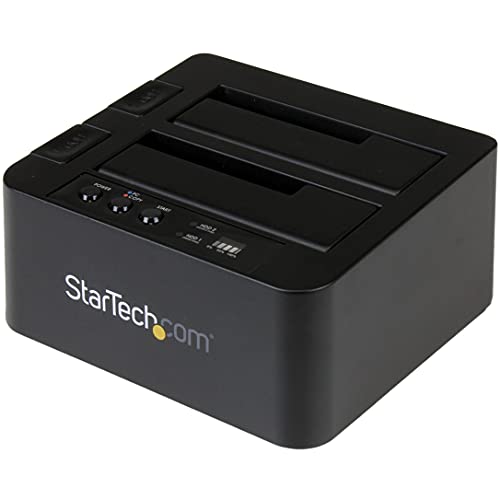
- Standalone sector-by-sector cloning
- Supports 4Kn, TRIM, and any-capacity SATA drives
- USB 3.2 Gen 2 with tool-less bays
Best For: IT professionals and advanced users with recurring cloning needs
Highest Capacity

- Supports up to 44TB total capacity
- Offline cloning with a dedicated button
- Compatible with Windows, Mac, Linux, and more
Best For: High-capacity users with mixed devices and SATA drives
Sanitization Specialist

- Standalone duplication and erasure
- Up to 90MB/s copying
- DoD 5220.22-M-compliant sanitization
Best For: Businesses and technicians handling drive duplication and disposal
Best Manual-Switching Dock

- Offline cloning without a computer
- Manual switch separates clone and transfer modes
- Supports two 2.5- or 3.5-inch SATA drives
Best For: Windows users wanting controlled dual-bay cloning
Best USB-C Option
FIDECO Dual-Bay Offline Cloner

- Includes USB-C and USB-A connection cables
- Offline cloning needs no computer
- Works with Windows, macOS, and Linux
Best For: Windows users needing flexible USB-C connectivity
Best High-Capacity Choice

- Supports up to 40TB across two bays
- One-key offline cloning with progress LEDs
- Tool-free support for 2.5- and 3.5-inch SATA drives
Best For: Windows users managing large SATA backup drives
Best USB-C Clone Dock
ORICO 2-Bay SATA Docking Station

- Offline cloning for 2.5- and 3.5-inch SATA drives
- USB-C and USB-A connectivity at up to 5Gbps
- Supports drives up to 22TB per bay
Best For: Windows users wanting USB-C flexibility and large-drive support
Best Hub-Style Duplicator
MAIWO Dual-Bay SATA Drive Cloner

- Offline cloning without a computer or drivers
- Three USB 3.0 Type-A hub ports
- Supports up to 48TB total across two bays
Best For: Windows workstations needing cloning and extra USB-A connectivity
Best Protected-Bay Dock

- Offline cloning for SATA HDDs and SSDs
- Fixed bezels help stabilize and protect drives
- Compatible with Windows 7, 8, 10, and 11
Best For: Windows users wanting simple, stable SATA drive cloning
Best Value – Sabrent Dual-Bay SATA Cloner
For shoppers comparing hard drive duplicators for windows, the Sabrent EC-HD2B is a straightforward dual-bay dock for cloning or accessing 2.5-inch and 3.5-inch SATA HDDs and SSDs. It supports offline cloning without drivers and drives up to 10TB per bay.
Best For: Home users and small offices that want an affordable, plug-and-play SATA cloning dock.
Pros:
- Supports both 2.5-inch and 3.5-inch SATA drives.
- Offline cloning requires no computer or drivers.
- USB 3.0 transfer speeds up to 5Gbps and support for up to 20TB total capacity.
Cons:
- Offline cloning is rated up to 60Mbps, slower than its USB connection speed.
- Designed for SATA drives rather than IDE or other interfaces.
The Sabrent is a practical choice when you need occasional drive duplication and a useful USB dock in one compact unit. Its two-year coverage requires product registration for the extended period.
IT Pro Pick – StarTech Dual-Bay SATA Duplicator
The StarTech SDOCK2U313R is a more feature-rich option among hard drive duplicators for windows, offering standalone, sector-by-sector cloning without a computer. It also functions as a USB-connected SATA dock for drive access and supports 2.5-inch and 3.5-inch drives of any capacity.
Best For: IT professionals and advanced users who need standalone duplication, 4Kn support, TRIM, and broad SATA compatibility.
Pros:
- Sector-by-sector cloning copies the entire drive, including empty sectors.
- Supports SATA I/II/III, 4Kn drives, TRIM, and drives of any capacity.
- USB 3.2 Gen 2 connectivity, tool-less bays, drive doors, and eject buttons.
Cons:
- The target drive must be equal to or larger than the source.
- IDE drives require a separately sold adapter.
- Sector-by-sector duplication may copy unused space and take longer than data-only cloning.
With its professional-oriented feature set and two-year warranty, this StarTech dock suits repeatable drive-copying workflows better than a basic consumer dock. Its OS-independent operation is useful when no cloning software is available.
Highest Capacity – ORICO 44TB Dual-Bay Cloner
The ORICO DD28U3-C combines a dual-bay dock with offline cloning, making it a flexible pick among hard drive duplicators for windows. It supports 2.5-inch and 3.5-inch SATA I/II/III drives and up to 44TB total capacity, with USB 3.0 access for backups and transfers.
Best For: Users who need high-capacity drive support and a dock that works across Windows, Mac, Linux, and several consumer devices.
Pros:
- Supports up to 44TB total, using two drives up to 22TB each.
- Offline cloning starts with a dedicated button and needs no computer.
- Works with PCs, laptops, smart TVs, routers, PS4, and multiple operating systems.
- Includes UASP, TRIM, tool-less drive swapping, and automatic sleep after inactivity.
Cons:
- The target drive must be larger than the source for offline cloning.
- The dock will not power on without a hard drive inserted.
- Its USB 3.0 interface is rated up to 5Gbps rather than USB 3.2 speeds.
The ORICO stands out for capacity and platform flexibility. It is a strong fit for mixed-device households or workspaces, provided the source and target drives meet the cloning-size requirement.
Sanitization Specialist – Systor Standalone Duplicator
The Systor SYS101HS-DP is a dedicated standalone duplicator and eraser for 2.5-inch and 3.5-inch SATA HDDs and SSDs. For buyers seeking hard drive duplicators for windows, it provides computer-free operation, simultaneous copying, and DoD 5220.22-M-compliant drive sanitization.
Best For: Businesses and technicians that need repeatable SATA duplication plus secure drive erasure.
Pros:
- Operates without a computer or software.
- Copies multiple HDDs or SSDs simultaneously at up to 90MB/s.
- Supports data-only or whole-drive duplication.
- Includes DoD 5220.22-M-compliant sanitization and hot-swappable drive support.
Cons:
- Its listed storage capacity is 3TB, lower than several newer high-capacity docks.
- Designed for SATA drives and does not list USB docking connectivity.
- Its 1:1 configuration is less suitable when you need several target copies at once.
The Systor is less of a general-purpose computer accessory and more of a focused duplication and erasure tool. Its sanitization function, metal enclosure, and lifetime technical support make it especially relevant for equipment turnover and service work.
Best Manual-Switching Dock – SSK Dual-Bay SATA Cloner
For shoppers comparing hard drive duplicators for windows, the SSK DK103 is a practical dual-bay option with a manual switch between offline cloning and PC data-transfer mode. It supports both 2.5- and 3.5-inch SATA HDDs and SSDs, with status LEDs and an aluminum enclosure for clearer operation and heat management.
Best For: Windows users who want a dual-bay SATA dock with a physical mode switch and offline cloning.
Pros:
- Offline cloning works without connecting to a computer.
- Supports two 2.5- or 3.5-inch SATA drives, with up to 20TB per drive according to the supplied notes.
- Manual switching helps separate cloning from PC transfer mode and reduce misoperation.
- LED indicators show power, drive position, and cloning progress.
Cons:
- Does not support hot-plugging.
- Uses USB 3.0 with a listed transfer rate of up to 5Gbps.
- The manual switch adds an extra step compared with one-button operation.
The SSK stands out when operational control matters more than the newest connection standard. Its aluminum construction, stable drive bays, and independent dual-drive transfers make it a sensible choice for routine Windows backups and disk migration.
Best USB-C Option – FIDECO Dual-Bay Offline Cloner
The FIDECO docking station is a flexible pick among hard drive duplicators for windows, especially if you switch between USB-C and USB-A computers. Its dual-bay design supports offline cloning of 2.5- and 3.5-inch SATA drives, while the included two cables make it easier to connect to different systems.
Best For: Windows users who need USB-C connectivity, broad operating-system compatibility, and straightforward offline cloning.
Pros:
- Includes both USB-C-to-USB-C and USB-C-to-USB-A cables.
- Supports Windows, macOS, and Linux with plug-and-play operation.
- Offline clone mode requires no computer; the target drive must be at least as large as the source.
- UASP and USB 3.2 Gen 1 provide transfer speeds up to 5Gbps.
Cons:
- Supports SATA drives only, not other drive interfaces.
- The enclosure is plastic rather than aluminum.
- Cloning requires the target drive to have capacity equal to or greater than the source.
FIDECO’s main advantage is connection flexibility. It is a good fit for mixed Windows setups where USB-C and USB-A ports are both in use, while its clearly defined source and target slots simplify standalone cloning.
Best High-Capacity Choice – SUITOK 40TB SATA Cloner Dock
For buyers seeking hard drive duplicators for windows with substantial storage support, the SUITOK dual-bay dock accommodates up to 20TB in each bay, or 40TB total. It combines one-key offline cloning with 5Gbps USB connectivity, tool-free vertical insertion, and compatibility with both 2.5- and 3.5-inch SATA drives.
Best For: Windows users handling high-capacity backups, system migration, or large SATA drive collections.
Pros:
- Supports up to 20TB per bay and 40TB total.
- One-key offline cloning works without a PC or laptop.
- Progress LEDs indicate 25%, 50%, 75%, and 100% completion.
- Supports UASP, TRIM, and S.M.A.R.T. features according to the supplied notes.
Cons:
- USB data transfer is limited to a listed 5Gbps.
- The open vertical design leaves inserted drives exposed rather than enclosed.
- Its extra compatibility and RGB features may be unnecessary for basic cloning.
The SUITOK is the strongest capacity-focused option in this group. Its tool-free bays and cloning progress display suit frequent drive work, while the additional protocol support makes it more appealing for users maintaining SSDs and large storage pools.
Best USB-C Clone Dock – ORICO 2-Bay SATA Docking Station
The ORICO 2-bay dock is a practical option for anyone comparing hard drive duplicators for Windows. It supports 2.5-inch and 3.5-inch SATA HDDs and SSDs, offers offline cloning without a computer, and connects over USB-C or USB-A at up to 5Gbps.
Best For: Windows users who want USB-C flexibility, offline drive cloning, and support for large-capacity SATA drives.
Pros:
- Offline cloning works by placing the source and target drives in the bays and starting the clone function.
- Supports 2.5-inch and 3.5-inch SATA HDDs and SSDs, with dual-drive capacity up to 22TB per drive.
- Includes a USB-C and USB-A 2-in-1 cable and supports UASP and TRIM.
- Dust-resistant, non-slip design and automatic sleep after 10 minutes.
Cons:
- The target disk must have greater capacity than the source disk for offline cloning.
- Its USB connection is limited to a stated 5Gbps transfer rate.
With broad device compatibility and a compact design, the ORICO is a versatile choice for routine backups, drive upgrades, and cloning tasks. Its USB-C connectivity is especially convenient for newer Windows laptops.
Best Hub-Style Duplicator – MAIWO Dual-Bay SATA Drive Cloner
The MAIWO dual-bay station combines offline drive cloning with a three-port USB 3.0 hub. For shoppers seeking hard drive duplicators for Windows, it supports both 2.5-inch and 3.5-inch SATA drives, provides up to 48TB of combined stated capacity, and includes an independent 12V power supply.
Best For: Windows desktop users who need a dual-bay cloner plus extra USB-A ports for storage devices or charging.
Pros:
- Clones from a source drive to a target drive without connecting to a computer or installing drivers.
- Supports 2.5-inch and 3.5-inch SATA HDDs and SSDs, with up to 24TB per port according to the product notes.
- Three USB 3.0 Type-A hub ports add convenient peripheral connectivity.
- LED indicators show clone progress at 25%, 50%, 75%, and 100%.
Cons:
- The product notes specify a USB 3.0 transfer bandwidth of up to 5Gbps.
- The unit requires its included 12V 3A power adapter.
The MAIWO stands out when a cloning dock also needs to serve as a small USB hub. Its independent power supply and progress indicators make it well suited to planned backup and data-transfer work at a Windows workstation.
Best Protected-Bay Dock – WAVLINK Dual-Bay SATA Cloner
The WAVLINK dual-bay dock offers offline cloning and tool-free access for 2.5-inch and 3.5-inch SATA drives. Among hard drive duplicators for Windows, it is a straightforward choice with a fixed-bezel design, USB 3.0 connectivity, UASP support, and compatibility with Windows 7 through Windows 11.
Best For: Windows users who prioritize stable drive positioning, simple plug-and-play operation, and broad SATA compatibility.
Pros:
- Offline cloning copies between two drives without requiring a computer.
- Supports SATA I, II, and III 2.5-inch and 3.5-inch HDDs and SSDs.
- Fixed bezels help provide stable positioning and added drive protection.
- Tool-free, hot-swappable operation with Windows 7/8/10/11 support.
Cons:
- The target drive should have capacity equal to or greater than the source drive.
- The product is designed for SATA drives only and includes a 12V/3A power adapter.
WAVLINK’s fixed-bezel design gives this dock a more secure feel than an open, unprotected bay. It is a sensible pick for Windows backup and drive-transfer tasks when ease of use and compatibility matter more than extra hub features.
How We Picked the Best Hard Drive Duplicators for Windows
We focused on practical features that affect Windows drive upgrades, backups, and recovery work. Each selected model supports SATA storage in at least one common 2.5-inch or 3.5-inch format, while many accept both hard drives and SATA SSDs. We also considered offline cloning, host-computer connectivity, USB generation, stated transfer rates, maximum supported capacity, power requirements, and useful extras such as USB hubs.
Specifications can vary by drive, computer, cable, and file system. Advertised cloning speeds are typically best-case figures, so treat them as comparisons rather than guaranteed real-world performance.
Quick Comparison
- Best for straightforward home cloning: A dual-bay offline dock with one-button duplication and support for both 2.5-inch and 3.5-inch SATA drives.
- Best for frequent technical work: A dedicated duplicator with clear progress indicators, erasing functions, and a high stated copy speed.
- Best for newer laptops and desktops: A USB-C model, especially if your computer has limited USB-A ports.
- Best for expanding desktop storage: A dock with high capacity support, stable external power, and convenient access to two drives.
Key Buying Factors for Hard Drive Duplicators for Windows
Offline Cloning Versus Software-Based Copying
Offline cloning copies one drive directly to another without Windows running a cloning application. It is useful for replacing a boot drive, but the target drive normally needs to be equal to or larger than the source. Software-based docks function more like external storage and may offer greater control over partitions, file systems, and selective copying.
Drive Size and SATA Compatibility
Check whether the dock accepts both 2.5-inch laptop drives and 3.5-inch desktop drives. Most models in this category are designed for SATA I, II, and III devices, but they do not support every interface. NVMe M.2 drives, IDE disks, and many specialized enterprise drives require different hardware or an adapter.
Connection Speed and Power
USB 3.0 or USB 3.2 Gen 1 is sufficient for many SATA SSD and HDD tasks, while USB-C may provide a more convenient connector. The dock cannot exceed the limits of the drive or computer port. Two-bay units with 3.5-inch drives also need a reliable power adapter; avoid relying on an underpowered hub.
Capacity, Indicators, and Safety
Choose a stated capacity limit above the largest drives you plan to use. Progress lights, a stable enclosure, ventilation, and a secure power switch make long transfers easier to monitor. Always verify the source and target positions before starting an offline clone, because the target drive is normally erased.
Who Should Buy Which Hard Drive Duplicators for Windows?
Choose a basic dual-bay dock if you occasionally clone Windows drives, access spare disks, or move data between SATA devices. Choose a dedicated duplicator if you regularly deploy, erase, or duplicate drives for clients and need faster workflow feedback. Choose USB-C for a modern laptop setup, but confirm that the included cable and your computer support the advertised USB speed. Choose a hub-equipped model if extra USB ports are genuinely useful, while prioritizing a simpler design if maximum reliability and minimal desk clutter matter most.