The best network audio players with headphone output combine convenient streaming with personal listening, making it easier to enjoy high-resolution music without turning on a full speaker system.
This roundup covers dedicated network streamers, CD and SACD players, Android-based audio devices, portable hi-fi players, and practical audio converters. The right choice depends on your source devices, headphone needs, preferred services, and how much control you want over your system.
Best 10 Network Audio Players with Headphone Output Picks for 2026
Flagship Android Powerhouse

- Android streaming with major third-party apps
- 7300mW-per-channel headphone output at 32 ohms
- HDMI, USB, Wi-Fi, Bluetooth, DLNA, AirPlay, and Roon Ready
Best For: Powerful headphone-centered desktop systems
Compact Network Decoder

- Ethernet-based stereo audio decoder
- Supports MP3, AAC+, WMA, Ogg Vorbis, and PCM
- Includes 3.5mm headphone and line-level outputs
Best For: Basic wired network audio and internet radio
Multi-Room Audiophile Streamer

- Dual-mono ESS DAC design with THX AAA headphone amplification
- BluOS streaming, AirPlay 2, Bluetooth, and multi-room support
- HDMI eARC, balanced XLR outputs, and 5-inch display
Best For: Premium headphone and whole-home listening systems
CD-and-Streaming Hi-Fi Hub

- CD playback plus network audio streaming
- Supports PCM 384 kHz/32-bit and DSD 128
- HDMI ARC, digital preamp control, and 3.5mm headphone jack
Best For: CD-focused two-channel systems with modern streaming
Reference Network Source
TEAC UD-701N USB DAC/Network Player

- Dedicated 4-pin XLR headphone amplifier
- Dual-mono design for channel separation
- Supports Bluetooth LDAC and aptX HD
Best For: High-end balanced headphone systems
Disc-and-Stream Hub

- HEOS network and multiroom functionality
- Plays CDs and SACDs
- Dedicated 3.5mm headphone output
Best For: Listeners combining discs, streaming, and headphones
Best Smartphone-Style Hi-Fi Player

- 4.4mm balanced and 3.5mm outputs
- Android 14 with 256GB storage
- 5G phone with 6.7-inch AMOLED display
Best For: Listeners wanting phone features and balanced headphone audio in one device
Best Network Streaming Player
- DLNA and AirPlay over built-in Wi-Fi
- 4.4mm, 3.5mm, and coaxial outputs
- Up to 660mW at 32 ohms
Best For: Portable and desktop listeners using NAS, AirPlay, or demanding headphones
Best Budget-Friendly Wireless Player

- Wi-Fi and two-way Bluetooth audio
- DSD512 and broad format support
- Up to 1TB expansion and 15-hour playback
Best For: Portable listening, exercise, and large local music libraries
Flagship Android Powerhouse – FiiO R9
The FiiO R9 is a feature-packed choice among network audio players with headphone output. It combines Android streaming, local network playback, a powerful headphone amplifier, USB DAC functions, HDMI connectivity, and a 6-inch touchscreen in one desktop component.
Best For: Headphone listeners who want high output power, broad connectivity, and access to third-party streaming apps.
Pros:
- Supports third-party apps including Amazon Music, Apple Music, Tidal, and Spotify through open Android.
- Powerful headphone amplification rated up to 7300mW per channel at 32 ohms.
- Offers DLNA, AirPlay, Roon Ready support, HDMI ARC, USB, Bluetooth, and Wi-Fi connectivity.
- 6-inch FHD touchscreen provides direct control without relying only on a phone.
Cons:
- Its extensive feature set may be more than needed for a simple streaming setup.
- The desktop all-in-one design is less suited to compact systems.
The R9 stands out when headphone performance and flexibility matter equally. Its combination of streaming, decoding, video-related HDMI features, and powerful amplification makes it a versatile centerpiece for a desktop or dedicated listening system.
Compact Network Decoder – Barix Exstreamer 100
The Barix Exstreamer 100 is a straightforward option among network audio players with headphone output. It uses Ethernet to decode internet audio and common file formats, then sends stereo sound through a line-level output or built-in 3.5mm headphone jack.
Best For: Practical internet-radio and network-audio installations that need Ethernet connectivity and basic headphone monitoring.
Pros:
- Decodes MP3, AAC+, WMA, Ogg Vorbis, and 16-bit PCM formats.
- Supports sample rates from 8 to 48 kHz.
- Includes 10/100 Ethernet, USB flash-memory support, stereo line output, and a 3.5mm headphone jack.
- Low-power design and remote-control operation suit unattended setups.
Cons:
- Ethernet is the listed network connection; Wi-Fi is not specified.
- It lacks the high-resolution and touchscreen features found on more advanced streamers.
The Exstreamer 100 favors reliability and simplicity over audiophile extras. It is a sensible fit for basic network playback, internet radio, or a fixed installation where Ethernet and a headphone output are the main requirements.
Multi-Room Audiophile Streamer – Bluesound NODE ICON
The Bluesound NODE ICON combines high-resolution network streaming with a dedicated headphone stage, making it a strong contender among network audio players with headphone output. Its BluOS platform, dual-mono DAC design, HDMI eARC, multi-room support, and THX AAA headphone amplifier give it broad system appeal.
Best For: Audiophiles building a premium BluOS multi-room system who also want convenient full-size headphone listening.
Pros:
- Dual ESS SABRE ES9039Q2M DACs and QRONO d2a technology target detailed, low-distortion playback.
- THX AAA headphone amplification supports listening through full-size 1/4-inch headphone jacks.
- Streams services and personal libraries through BluOS, with AirPlay 2 and aptX Adaptive Bluetooth.
- Supports HDMI eARC, balanced XLR outputs, Dirac Live upgrade capability, and Bluesound multi-room playback.
Cons:
- Dirac Live requires an upgrade and a separately purchased calibration microphone kit.
- Its premium features may be excessive for users who only need basic streaming.
The NODE ICON is especially compelling for listeners who want one streamer to serve headphones, a stereo system, television, and whole-home audio. Its strongest advantage is the combination of audiophile-oriented conversion and a mature multi-room platform.
CD-and-Streaming Hi-Fi Hub – Marantz CD 50n
The Marantz CD 50n is a traditional CD player expanded with network audio features, making it a polished option among network audio players with headphone output. It supports high-resolution PCM and DSD playback, includes HDMI ARC for TV audio, and offers a 3.5mm headphone jack for private listening.
Best For: CD collectors who want network streaming, high-resolution playback, and headphone compatibility in a premium two-channel component.
Pros:
- Plays CDs while supporting PCM up to 384 kHz/32-bit and DSD 128.
- HDMI ARC provides a simple connection for TV, movie, and game audio.
- Built-in digital preamp functionality allows volume adjustment through HEOS or the remote when driving a power amplifier.
- Includes a 3.5mm headphone jack and network audio streaming features.
Cons:
- It is a larger, premium component designed around two-channel systems rather than portable use.
- The supplied details do not specify the full range of supported streaming services.
The CD 50n is a strong choice when physical discs remain central to your listening habits. Its network functionality, HDMI ARC, digital volume control, and headphone jack add modern flexibility without abandoning the dedicated CD-player format.
TV Audio Bridge – HDMI ARC Headphone Extractor
For shoppers seeking network audio players with headphone output, this HDMI ARC extractor is a practical TV-focused alternative rather than a network player. It converts audio from a compatible HDTV’s HDMI ARC port to optical or 3.5mm analog output, making it useful with headphones, amplifiers, and older speakers.
Best For: TV listeners who need a simple wired headphone output from an HDMI ARC-equipped television.
Pros:
- Provides a 3.5mm AUX output for headphones and an optical output for compatible audio systems.
- Supports audio sampling rates up to 192kHz.
- Includes an HDMI ARC cable, optical cable, and USB-C power cable.
Cons:
- Works with HDTV ARC ports, not standard HDMI inputs or other HDMI devices.
- The 3.5mm output supports LPCM only.
- Some TVs require ARC activation and disabling the built-in TV speakers.
This is best viewed as a convenient TV audio converter, not a standalone streaming or network audio player. Confirm your television has HDMI ARC and be prepared to control volume on the connected audio device if the TV does not support ARC volume control.
Reference Network Source – TEAC UD-701N USB DAC/Network Player
The TEAC UD-701N is the closest fit here for shoppers comparing network audio players with headphone output. It combines network-player functionality with a USB DAC, analog preamplifier features, multiple digital inputs, Bluetooth reception, and a dedicated 4-pin XLR headphone amplifier.
Best For: Serious headphone listeners building a high-end digital audio system with balanced headphone connectivity.
Pros:
- Includes a 4-pin XLR headphone amplifier with balanced and active-ground switching.
- Uses a dual-mono structure designed to reduce left/right channel interference.
- Provides RCA/XLR line inputs, four digital inputs, and Bluetooth support including LDAC and aptX HD.
- Includes an MQA full decoder that also supports digital inputs.
Cons:
- The supplied details do not specify a 3.5mm headphone output.
- Its feature set and full-size design may be more than needed for a basic headphone setup.
- The product details list a USB-B connector but do not specify all network-service compatibility.
With its balanced headphone stage and broad input selection, the UD-701N is suited to a carefully assembled reference system. Choose it when balanced 4-pin XLR headphone connectivity matters more than a compact form factor or a basic plug-and-play approach.
Disc-and-Stream Hub – Marantz SACD 30n with HEOS
The Marantz SACD 30n is a versatile choice for shoppers considering network audio players with headphone output and physical-disc playback. Its HEOS built-in platform supports streaming and multiroom use, while the player also handles CDs, SACDs, digital files, and a dedicated 3.5mm headphone connection.
Best For: Music listeners who want network streaming, CD/SACD playback, and private listening from one component.
Pros:
- Combines HEOS network functionality with CD and SACD playback.
- Includes a dedicated headphone amplifier and 3.5mm headphone jack.
- Supports digital connections including optical and USB Type-A.
- Designed for multiroom and high-resolution audio use.
Cons:
- It is a full-size disc player rather than a compact network-only streamer.
- The supplied details do not identify the specific streaming services included.
- Its premium feature set may be unnecessary for listeners who only need headphone streaming.
The SACD 30n stands out when your library includes both discs and network sources. Its integrated headphone section makes private listening straightforward, while HEOS adds multiroom and streaming flexibility for a broader home audio setup.
Best Smartphone-Style Hi-Fi Player – MOONDROP MIAD01
MOONDROP MIAD01 MD-PH-001 5G Mobile Phone Internet HiFi Audio Device Music Player
Check Price On AmazonThe MOONDROP MIAD01 is an unusual option among network audio players with headphone output: it combines a 5G Android phone with dedicated 3.5mm single-ended and 4.4mm balanced headphone connections. It suits listeners who want streaming, apps, and everyday phone functionality without carrying a separate digital audio player.
Best For: Music listeners who want a full-size smartphone experience alongside balanced Hi-Fi headphone output.
Pros:
- Provides both 4.4mm balanced and 3.5mm headphone outputs.
- Runs Android 14 with 12GB RAM, 256GB storage, and support for up to 2TB expansion.
- Includes 5G connectivity, a 6.7-inch 120Hz AMOLED display, and a 5,000mAh battery.
Cons:
- Its large smartphone form factor may be less pocketable than a dedicated compact player.
- The supplied notes do not specify particular streaming services or network-audio protocols.
The MIAD01 is best viewed as a phone-first Hi-Fi device rather than a traditional network streamer. Its dual headphone outputs and generous storage make it flexible for local and app-based listening, while the large display supports broader multimedia use.
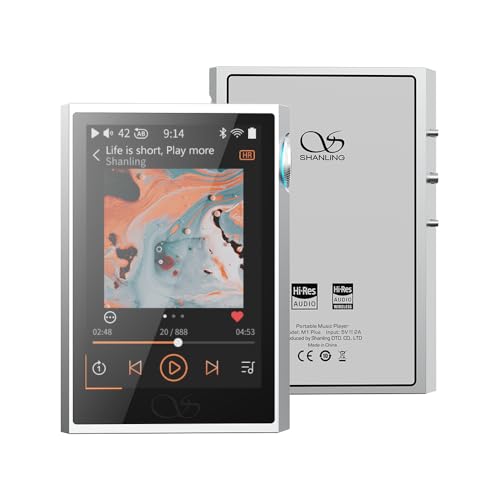
Best Network Streaming Player – SHANLING M1 Plus
The SHANLING M1 Plus is a strong fit for shoppers comparing network audio players with headphone output. Its built-in Wi-Fi supports DLNA and AirPlay streaming from a home network or NAS, while 4.4mm balanced and 3.5mm outputs cover both portable headphones and more demanding full-size models.
Best For: Listeners who want compact network streaming, local playback, and powerful wired headphone output.
Pros:
- Supports Wi-Fi streaming through DLNA and AirPlay.
- Offers 4.4mm balanced, 3.5mm single-ended, and 3.5mm coaxial S/PDIF outputs.
- Uses an ESS ES9069Q DAC and dual amplifiers rated up to 660mW at 32 ohms.
- Compact aluminum-and-glass design weighs approximately 116 grams.
Cons:
- Its approximately 12.5-hour playback time is shorter than some simpler players.
- Internal storage is listed at 32GB, so a microSD card may be useful for larger libraries.
For a dedicated network-capable player, the M1 Plus offers an especially complete connection set. It can act as a portable source, a NAS or AirPlay endpoint, or a digital bridge for a desktop system, while retaining two analog headphone outputs.
Best Budget-Friendly Wireless Player – HiFi MP3 Player
This HiFi MP3 player is a compact choice for shoppers seeking network audio players with headphone output and broad format support. It combines Wi-Fi, Bluetooth, local playback, a touch display, and expandable storage in a lightweight body designed for portable listening.
Best For: Casual listeners who want wireless connectivity, extensive file support, and a lightweight player for travel or exercise.
Pros:
- Supports native DSD512 playback and numerous lossless audio formats.
- Includes Wi-Fi and two-way Bluetooth with LDAC, SBC, and AAC support.
- Offers up to 15 hours of headphone or Bluetooth playback and storage expansion to 1TB.
- Lightweight 134g design includes a 2.8-inch touch display and built-in speaker.
Cons:
- The supplied details do not identify a specific wired headphone-output specification.
- Bluetooth is listed as version 4.1, older than the Bluetooth 5.2 connection on the SHANLING player.
- Built-in storage is 16GB before expansion.
This player emphasizes portability and file compatibility rather than the advanced output connectivity of the SHANLING. Its Wi-Fi access, two-way Bluetooth, long stated battery life, and 1TB expansion make it practical for listeners building a large mobile music library.
How We Picked the Best Network Audio Players with Headphone Output
We selected products across several listening setups rather than treating every device as a traditional hi-fi streamer. The lineup includes network players with dedicated headphone functionality, CD and SACD players with streaming features, Android and portable players, and compact devices designed to route digital or TV audio to headphones.
Our priorities were connection flexibility, supported audio formats, streaming access, headphone usability, system compatibility, and overall value. Because headphone outputs vary substantially, check each product’s specifications before buying—some are designed for demanding wired headphones, while others are better suited to efficient earbuds or casual listening.
Quick Comparison
| Best For | Look For | Most Suitable Product Types |
|---|---|---|
| Dedicated home streaming | Network services, app control, DAC quality, stable software | Bluesound, TEAC, Marantz |
| Disc and streaming systems | CD/SACD playback, HEOS or network integration, analog outputs | Marantz CD and SACD players |
| Headphone-focused digital playback | Powerful amplification, balanced outputs, local file support | FiiO, Shanling, MOONDROP |
| TV or soundbar integration | ARC support, optical or RCA output, volume compatibility | HDMI audio extractor |
| Installed audio and basic network decoding | Reliable IP streaming and simple system integration | Barix Exstreamer |
Key Buying Factors for Network Audio Players with Headphone Output
Headphone Power and Output Type
Check whether the output is a dedicated headphone amplifier or simply a shared analog jack. High-impedance headphones may need more voltage, while low-sensitivity planar headphones often benefit from higher current. Balanced outputs can provide additional power on compatible headphones, but they are not automatically better.
Streaming Services and Network Features
Confirm support for the services you actually use, such as Spotify Connect, Tidal, Qobuz, Apple AirPlay, Chromecast, Roon, or proprietary multi-room platforms. Also consider whether the device uses Wi-Fi, Ethernet, or both, and whether its control app is regularly maintained.
Digital Formats and Connection Options
Look for the file resolution and formats you need, including FLAC, WAV, ALAC, DSD, and MQA where relevant. USB, optical, coaxial, HDMI ARC, Bluetooth, and line-level outputs determine how easily the player will fit into an existing system.
Portability and Everyday Controls
Portable models make sense for local music, travel, and direct headphone listening, while full-size components are better for permanent rack or desktop systems. Screen quality, physical controls, battery life, and storage support can matter as much as headline specifications.
Who Should Buy Which Network Audio Players with Headphone Output?
Choose a Bluesound, TEAC, or Marantz network component if you want a long-term home audio source connected to an amplifier, powered speakers, or headphones. Select a FiiO, MOONDROP, or Shanling player if headphones and local high-resolution playback are your main priorities. A Marantz disc-based model is the better match for listeners who still use CDs or SACDs. For TV listening, the HDMI ARC extractor is the practical choice, while the Barix unit is aimed more at straightforward IP audio distribution than personal hi-fi use.
Before ordering, verify headphone impedance compatibility, output levels, app support, regional streaming availability, and the required cables. Those details will determine whether a feature-rich player feels effortless or unnecessarily complicated in your system.