Choosing the right rackmount digital mixing console can make setup faster, routing simpler, and live mixing far more flexible.
Below, we focus on the features that matter most so you can narrow the field quickly and buy with confidence.
Best 10 Rackmount Digital Mixing Console Picks for 2026
Rackmount Digital Mixer Pick
Behringer X32 RACK 40-Input Rack Mixer

- 40-input, 25-bus rackmount design
- 16 MIDAS-designed programmable preamps
- 32 x 32 USB interface with iPad/iPhone control
Best For: Live sound and installed setups needing compact remote-controlled mixing
Hands-On Console Choice
Yamaha TF3 24-Channel Digital Mixing Console

- 25 motor faders for direct control
- 48 input mixing channels with 20 aux buses
- USB and Wi-Fi connectivity
Best For: Users who prefer tactile control and flexible digital routing
Compact Digital Rack Option
Behringer X32 Compact 40-Input Console

- 40-input, 25-bus digital mixing console
- 17 motorized 100 mm faders
- 16 MIDAS-designed programmable preamps
Best For: Studio and live mixing where tactile control still matters
Networked Rackmount Upgrade
Allen & Heath SQ-Rack Digital Rackmount Mixer

- 96kHz processing for high-resolution audio
- Dante, Waves, MADI, and SLink compatibility
- SQ-Control, SQ-MixPad, and SQ4You app support
Best For: Networked and installed systems needing flexible digital expansion
Flagship Live/Studio Control

- 40-input, 25-bus digital mixer
- 32 MIDAS-designed programmable preamps
- Motorized faders and scribble strips
Best For: Large live and studio setups that need deep routing and fast control
Compact Rackmount Value

- 3U rackmount mixer with front-panel access
- Bluetooth streaming to channels 9-10
- 4 mic/line preamps with phantom power
Best For: Smaller venues and mobile rigs that need a simple rackmount mixer with Bluetooth
High-Channel Digital Desk

- 48 input channels with 33 motor faders
- 20 aux plus stereo and sub buses
- USB and Wi-Fi connectivity
Best For: Large productions and installs needing lots of channels and hands-on control
Tablet-Controlled Rack Mixer
Behringer X AIR XR18 18-Channel Digital Mixer
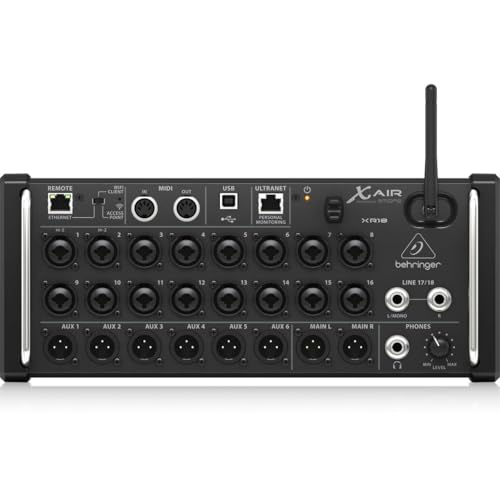
- 18-input mixer for iPad/Android control
- 16 MIDAS-designed programmable preamps
- Built-in Wi‑Fi and 18 x 18 USB audio
Best For: Small live rigs and studios needing tablet control and multitrack recording
Rack-Mount Portable Console
Yamaha TF1 16-Channel Digital Mixing Console

- Rack mountable with 17 motor faders
- 40 input mixing channels and 20 aux buses
- 16 combo inputs plus Wi‑Fi and USB
Best For: Portable small systems that need lots of routing and motorized control
Rack-Kit Compact Mixer
Allen & Heath CQ-12T 10-Channel Digital Mixer

- Includes rackmount kit for secure setup
- 96kHz audio with Smart-FX and assistants
- SD and USB recording options
Best For: Compact installs and portable rigs needing guided setup and rack mounting
Rackmount Digital Mixer Pick – Behringer X32 RACK 40-Input Rack Mixer
If you need a rackmount digital mixing console that keeps a full-featured workflow in a compact 3U form factor, the Behringer X32 RACK is built for exactly that job. It offers 40 input channels, 25 buses, 16 MIDAS-designed preamps, and remote control from iPad or iPhone, making it a practical choice for live sound and installed systems where space and flexibility matter.
Best For: Live sound or installed rigs that need a compact rack mixer with remote control and strong I/O flexibility.
Pros:
- 40-input, 25-bus layout supports larger routing needs in a rackmount footprint.
- 16 fully programmable MIDAS-designed preamps add serious front-end flexibility.
- 32 x 32 USB 2.0 audio interface expands recording and computer integration options.
- iPad and iPhone control lets you manage the mix without a host PC.
Cons:
- Rack-only format is less hands-on than a full-size console with faders.
- No motorized faders are listed in the supplied details.
- Best suited to users comfortable working through remote control and software workflows.
Overall, the X32 RACK is a strong pick when you want a serious rackmount digital mixing console with wide channel count, USB audio, and mobile control in a space-saving package.
Hands-On Console Choice – Yamaha TF3 24-Channel Digital Mixing Console
The Yamaha TF3 is a practical rackmount digital mixing console alternative when you want a compact digital board with more tactile control than a purely rack-based mixer. It features 25 motor faders, 48 input mixing channels, 20 aux buses, and both USB and Wi-Fi connectivity, so it can cover a wide range of live applications while staying manageable.
Best For: Operators who want a compact digital console with lots of hands-on control and flexible connectivity.
Pros:
- 25 motor faders provide quick, physical control over channels and the master.
- 48 input mixing channels give plenty of headroom for larger mixes.
- 20 aux buses plus stereo and sub buses support flexible routing.
- USB and Wi-Fi connectivity add convenient workflow options.
Cons:
- It is larger and less rack-oriented than a dedicated rackmount digital mixing console.
- Only 24 channels are noted in the supplied details, so it may not fit every channel-count expectation at a glance.
- Heavier and bulkier than compact rack mixers.
The TF3 stands out for users who want a mix of digital flexibility and physical fader control, especially when a rack-only unit would feel too stripped down.
Compact Digital Rack Option – Behringer X32 Compact 40-Input Console
The Behringer X32 Compact is a strong rackmount digital mixing console option if you want the X32 platform in a more compact, workflow-friendly format. It delivers 40 input channels, 25 buses, 16 MIDAS-designed preamps, and 17 fully automated motorized faders, making it useful for studio and live work where quick access matters.
Best For: Studio and live users who want a compact digital mixer with motorized faders and broad routing.
Pros:
- 40-input, 25-bus design gives it plenty of mix capacity.
- 16 MIDAS-designed programmable mic preamps support quality input handling.
- 17 motorized 100 mm faders make scene changes and navigation more efficient.
- LCD Scribble Strips help with clear channel and bus identification.
Cons:
- Still more console-like than a true rack-only mixer.
- Heavier than rack units such as the X32 RACK.
- Users looking for a minimalist rack footprint may find it too large.
For buyers who want the X32 feature set with more physical control, the Compact is a balanced middle ground between rack convenience and console-style operation.
Networked Rackmount Upgrade – Allen & Heath SQ-Rack Digital Rackmount Mixer
The Allen & Heath SQ-Rack is a modern rackmount digital mixing console built around 96kHz processing and flexible network expansion. With Dante, Waves, MADI, and SLink connectivity options, plus app compatibility for SQ-Control, SQ-MixPad, and SQ4You, it is aimed at users who need a rack-based mixer that can integrate into more advanced systems.
Best For: Installed, touring, or networked audio setups that need high-rate processing and expansion options.
Pros:
- 96kHz processing supports a high-resolution digital workflow.
- Dante, Waves, MADI, and SLink compatibility offer broad integration potential.
- App support adds flexible remote operation from supported devices.
- Rackmount format keeps the system compact and installation-friendly.
Cons:
- Expansion depends on the available option card slot and chosen ecosystem.
- No physical fader layout is listed in the supplied details.
- It is best suited to users already planning for networked audio workflows.
The SQ-Rack is the most connectivity-focused choice here, making it a compelling rackmount digital mixing console for setups that need serious digital integration and remote control.
Flagship Live/Studio Control – Behringer X32
The Behringer X32 is a rackmount digital mixing console built for users who need a full-featured control surface for studio and live work. With 40 inputs, 25 buses, and 32 fully programmable MIDAS-designed mic preamps, it offers the channel count and routing depth needed for larger setups. The motorized faders and scribble strips also make it easier to manage complex mixes quickly.
Best For: Front-of-house, studio, and live production users who need lots of inputs, buses, and fast scene-based control.
Pros:
- 40-input, 25-bus digital mixing console for studio and live application
- 32 MIDAS-designed programmable mic preamps for audiophile sound quality
- 25 fully automated motorized 100 mm faders for instant overview and scene management
- 16 XLR outputs plus 6 additional line in/outputs, 2 phones connectors, and talkback section
Cons:
- Large physical footprint compared with compact rack mixers
- More console than minimalist rackmount solution
- May be more mixer than smaller venues or simple playback rigs need
The X32 stands out when you want a rackmount digital mixing console that can handle a serious input list and still stay organized on the fly. Its motorized faders, programmable preamps, and clearly labeled channels make it a practical choice for demanding setups.
Compact Rackmount Value – Alesis MultiMix 10 Wireless
The Alesis MultiMix 10 Wireless is a practical rackmount digital mixing console option for smaller venues, houses of worship, and mobile systems. Its 3U rackmount design keeps things compact, while Bluetooth pairing makes it easy to stream audio straight to channels 9-10. The front-panel access and straightforward channel controls are aimed at quick setup and everyday use.
Best For: Smaller clubs, worship spaces, and travel rigs that want a compact mixer with Bluetooth playback.
Pros:
- Compact 3U rackmount format with easy-access front panel inputs
- Bluetooth streaming to channels 9-10 with single-button pairing
- 4 high-gain mic/line preamps with inserts and phantom power
- Each channel includes trim, peak LED, and smooth-travelling 60mm fader
Cons:
- 10 channels is modest for larger productions
- Not as deep or expandable as full-size digital consoles
- Best suited to simpler routing needs rather than complex mixes
If your priority is a rackmount digital mixing console that stays compact and easy to run, the MultiMix 10 Wireless makes sense. It balances basic live-mix tools with Bluetooth convenience for smaller systems.
High-Channel Digital Desk – Yamaha TF5
The Yamaha TF5 is a rackmount digital mixing console choice for larger applications that need high input capacity and plenty of faders. It offers 48 input mixing channels, 33 motor faders, and a broad bus structure with 20 aux sends plus stereo and sub buses. With USB and Wi-Fi connectivity, it is set up for modern digital workflows in demanding environments.
Best For: Larger live productions and installations that need many channels, many faders, and digital connectivity.
Pros:
- 48 input mixing channels with 32 analog XLR/TRS combo mic/line inputs
- 33 motor faders for fast hands-on control
- 20 aux buses plus stereo and sub buses for flexible routing
- USB and Wi-Fi connectivity for modern system integration
Cons:
- Substantial size and weight compared with smaller rack mixers
- Likely more console than basic playback or small club use requires
- Best suited to users who need and will use the higher channel count
The TF5 is a strong fit when the priority is channel density and operational speed rather than a minimal footprint. For users building a larger rackmount digital mixing console setup, it brings the faders and routing depth to match more complex productions.
Tablet-Controlled Rack Mixer – Behringer X AIR XR18 18-Channel Digital Mixer
The Behringer X AIR XR18 is a practical rackmount digital mixing console choice for users who want tablet-based control, a compact footprint, and flexible recording options. With 18 input channels, 16 MIDAS-designed preamps, built-in Wi‑Fi, and a bidirectional 18 x 18 USB interface, it fits well in live sound and studio workflows where fast setup and remote mixing matter.
Best For: Small live rigs, project studios, and tablet-driven mixes that need built-in Wi‑Fi and multichannel USB recording.
Pros:
- 18-input digital mixer controlled from iPad or Android tablets
- 16 programmable MIDAS-designed mic preamps for flexible input handling
- Built-in tri-mode Wi‑Fi router for direct operation without an external router
- 18 x 18 bidirectional USB interface for direct multichannel recording
Cons:
- Tablet-based workflow may not suit users who prefer lots of physical controls
- Dugan-style auto-mixing is listed as a future firmware feature
Overall, the XR18 stands out as a streamlined rackmount digital mixing console for compact systems that value remote control and straightforward digital recording. It is especially appealing when you want a lot of input capability without a large control surface.
Rack-Mount Portable Console – Yamaha TF1 16-Channel Digital Mixing Console
The Yamaha TF1 is a strong rackmount digital mixing console option for smaller systems that still need serious routing and hands-on control. It combines 16 analog combo inputs with 40 input mixing channels, 20 aux buses, Wi‑Fi and USB connectivity, and 17 motor faders, making it a versatile fit for portable events and compact installations.
Best For: Smaller live sound setups and portable systems that want a rack-mountable console with lots of mix flexibility and motorized faders.
Pros:
- Rack mountable design in a compact, portable format
- 17 motor faders for clear hands-on mixing control
- 40 input mixing channels and 20 aux buses for flexible routing
- 16 XLR/TRS combo inputs plus RCA stereo line inputs
Cons:
- Heavier than ultra-compact tablet-only mixers
- May be more console than some very small setups require
In practice, the TF1 gives you a lot of mixer in a size that can still work in a rack-friendly setup. If you want a balance of portability, channel count, and physical faders, it is an easy model to consider.
Rack-Kit Compact Mixer – Allen & Heath CQ-12T 10-Channel Digital Mixer
The Allen & Heath CQ-12T is a compact rackmount digital mixing console solution for users who want a small, modern mixer with easy setup tools. It offers 96kHz audio quality, Quick Inputs, Preamp Gain and Feedback Assistants, Smart-FX, and SD/USB recording, and the included rackmount kit makes installation more organized and secure.
Best For: Portable setups and small installs that benefit from rack mounting, guided setup tools, and high-resolution audio.
Pros:
- Included rackmount kit for secure, organized installation
- 96kHz audio quality for detailed sound
- Quick Inputs and setup assistants simplify operation
- SD and USB recording options add flexibility
Cons:
- 10-channel design is smaller than many full-size digital consoles
- Best suited to compact systems rather than large channel-count rigs
For buyers prioritizing a compact rack-friendly mixer, the CQ-12T offers a polished feature set without adding complexity. Its guided tools and included rack hardware make it especially practical for users who want a tidy, efficient setup.
How We Picked the Best Rackmount Digital Mixing Console
We prioritized real-world usability, not just channel count. The best Rackmount Digital Mixing Console options balance input capacity, flexible outputs, reliable remote control, onboard processing, and a workflow that suits either live sound or installed systems.
We also looked at connectivity, app support, size and weight, preamp quality, and whether each model can serve as the center of a compact rig or a more permanent install.
Quick Comparison
For larger live setups, full-featured 32-channel models offer the most routing and scene-management power. Mid-size consoles are a strong fit for churches, rehearsal rooms, and clubs that need versatility without unnecessary bulk. Smaller rack mixers and tablet-first systems are better when portability, hidden installation, or simple stage-to-FOH control matters most.
Key Buying Factors for a Rackmount Digital Mixing Console
Channel Count and Bus Flexibility
Choose enough inputs for your current setup, then leave room for growth. Bus count matters too, especially if you need monitor mixes, subgrouping, or dedicated outputs for recording and streaming.
Control Method
Some users want physical faders and a traditional surface, while others prefer app-based control from a tablet or phone. A Rackmount Digital Mixing Console is often chosen to save space, so make sure the control method still feels practical in your environment.
Connectivity and Integration
Check for USB audio, stagebox compatibility, Bluetooth when useful, and network or Wi-Fi options if you plan to mix remotely. These features can make a big difference for hybrid live and recording workflows.
Processing and Recall
EQ, compression, gating, scenes, and effects engines reduce the need for outboard gear and speed up repeatable setups. Presets and recall are especially valuable for venues with changing performers or frequent events.
Who Should Buy Which Rackmount Digital Mixing Console?
If you need maximum routing power for bands, houses of worship, or production work, a larger 32-channel-class model is usually the safest choice. If portability and space savings matter more, a compact or tablet-controlled Rackmount Digital Mixing Console may be the better fit.
For fixed installations, focus on remote control, silent operation, and ease of access. For mobile rigs, prioritize weight, ruggedness, and quick setup. Matching the mixer to your workflow is more important than chasing the biggest spec sheet.