Choosing a sampler for live performance means balancing speed, reliability, and control under real stage pressure. The best options make it easy to trigger clips, shape sounds, and build transitions without slowing the show down.
In this roundup, we focus on portable, performance-friendly gear that fits different workflows, from pad-based beatmaking to standalone sampling and hybrid mixer setups.
Best 10 Sampler for Live Performance Picks for 2026
Performance Sampler Icon

- 17 RGB velocity-sensitive pads
- Fast chopping, resampling, and editing
- Heavy onboard effects for live sets
Best For: Beatmakers and performers who want a compact sampler with deep effects
Portable Groovebox Sampler

- Standalone with battery, speaker, and mic
- Four flexible tracks for sampler or synth use
- On-device slicing and internal resampling
Best For: Portable creators who want hands-on sampling and Ableton workflow
Pocket Granular Sampler

- Built-in mic for quick sample capture
- Chop, step-sample, and resample on device
- Granular engine for detailed sound shaping
Best For: Performers who want a tiny sampler with granular editing
Pad Controller Performance Pick

- 16 velocity- and pressure-sensitive RGB pads
- 8 banks, 20 buttons, and 4 encoders
- Includes Studio One Artist and Ableton Live Lite
Best For: Software-based performers who want expressive pad triggering
Portable MPC Workflow
Akai MPC Sample Standalone Portable Sampler

- Standalone battery-powered sampler with built-in speaker and mic
- 16 MPC pads, full-color display, and fast chop/resample tools
- USB-C audio/MIDI plus stereo I/O for studio or live rigs
Best For: Live performers, DAWless creators, and portable sampling
Experimental Performance Tool

- Four stereo tracks with granular, filter, color, and space processing
- Scenes and macros support live recall and hands-on shaping
- Per-track modulation adds movement and expressive control
Best For: Experimental performers and sound designers
Pad Controller Value
Akai MPD218 USB MIDI Controller

- 16 MPC pads for triggering samples and drums
- Three pad banks expand control to 48 assignable pads
- USB-powered with 18 assignable knobs for live control
Best For: Laptop performers and finger drummers using software
Live-Show Sampling Pad

- 1000 built-in sounds and 30 kits
- Bluetooth sampling from phone or computer
- 32GB internal storage with FX and LEDs
Best For: drummers and live performers needing a compact sampling pad
Portable Live Mixer
Zoom LiveTrak L6max Mixer Recorder

- Built-in sound pads trigger samples on demand
- Records up to 14 tracks simultaneously
- Battery, USB, or mobile battery pack powered
Best For: performers and creators who need a portable mixer-recorder with sampling
Standalone Beat Center
Akai Professional MPC Live III
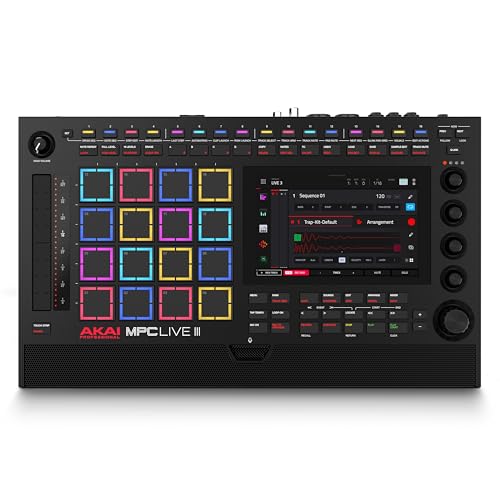
- Fully standalone with no computer required
- Expressive MPCe pads and touch-strip control
- Battery power with 128GB internal storage
Best For: beatmakers who want a standalone live performance sampler and sequencer
Performance Sampler Icon – Roland SP-404MKII
If you want a sampler for live performance that’s built around fast hands-on beatmaking, the SP-404MKII is the classic choice with meaningful upgrades. It’s designed for quick sample capture, chopping, resampling, and effects-heavy performance without slowing down your workflow.
Best For: Beatmakers and performers who want a compact sampler with deep effects and fast editing.
Pros:
- 17 velocity-sensitive RGB pads with a no-click design for smooth performance.
- Fast workflow with quick startup, rapid sample editing, and 16 GB internal storage.
- 32-voice polyphony and 160 samples per project for more flexible programming.
- Extensive onboard effects, including Vinyl Simulator, DJFX Looper, and new lo-fi tools.
Cons:
- It’s a dedicated hardware sampler, so it won’t replace a full DAW workflow.
- The compact design prioritizes performance controls over a large control surface.
For live sets that depend on immediate sample access and expressive effects, the SP-404MKII remains one of the most capable performance samplers available. Its speed, portability, and deep onboard processing make it easy to build a set around.
Portable Groovebox Sampler – Ableton Move
Ableton Move is a strong pick if you want a sampler for live performance that also works as a standalone sketchpad. With a battery, speaker, microphone, and onboard processing, it lets you capture sounds, slice them, and build sets away from the computer.
Best For: Portable creators who want hands-on sampling, sequencing, and Ableton workflow in one device.
Pros:
- Standalone operation with built-in rechargeable battery, speaker, microphone, and processor.
- Four flexible tracks can function as a drum kit, sampler, or synthesizer.
- On-device sample slicing and internal resampling support quick live idea building.
- Includes Ableton Live 12 Intro plus 64 GB onboard storage and 1,500+ sounds.
Cons:
- Live 12 Intro has limited tracks and instruments compared with the full version.
- The four-track layout may feel constrained for larger productions.
Move is best when you want to sketch, sample, and perform in a highly portable setup. Its integration with Ableton tools adds extra value if your live workflow continues on the computer afterward.
Pocket Granular Sampler – Roland AIRA Compact P-6
The Roland AIRA Compact P-6 is a compact sampler for live performance that focuses on quick capture, slicing, and granular sound design. It’s a practical option when you want a pocket-size tool for building loops and reshaping samples on the fly.
Best For: Performers who want a tiny sampler with granular editing and easy loop creation.
Pros:
- Built-in mic makes it easy to capture samples quickly.
- Chop and step-sampling functions help turn audio into playable parts fast.
- Granular controls add detailed sound-shaping options.
- Resampling and custom loop creation support evolving live sets.
Cons:
- The very small size may limit hands-on control compared with larger samplers.
- Best suited to compact workflows rather than sprawling sample projects.
If portability matters most, the P-6 gives you a focused live-performance sampler with useful sound-design depth. Its combination of sample capture, chopping, and granular editing makes it more flexible than its size suggests.
Pad Controller Performance Pick – PreSonus ATOM
PreSonus ATOM is a practical choice if your sampler for live performance lives inside software and you want a responsive pad controller to trigger it. It’s built to keep your hands on the beat with expressive pads, assignable controls, and tight integration with music production software.
Best For: Software-based performers who want expressive pad triggering and DAW control.
Pros:
- 16 velocity- and pressure-sensitive RGB pads for expressive triggering.
- 8 pad banks plus 20 assignable buttons and 4 rotary encoders for flexible control.
- Includes Studio One Artist and Ableton Live Lite, plus extra plug-ins and loops.
- USB compatibility with most music production and performance software.
Cons:
- It’s a controller, not a standalone sampler.
- Performance depends on your connected software and computer setup.
ATOM makes the most sense if you already perform with a laptop or tablet and need a tactile way to launch samples and loops. It’s less of an all-in-one box, but very capable as the hands-on front end for a software rig.
Portable MPC Workflow – Akai MPC Sample Standalone Portable Sampler
If you want a sampler for live performance that stays portable without giving up the core MPC feel, the Akai Professional MPC Sample is built for fast, hands-on use. It runs standalone on battery power, includes a built-in speaker and mic, and gives you the quick chopping, resampling, and pad-based workflow needed for spontaneous sets.
Best For: Live performers, DAWless creators, and beatmakers who want a compact standalone MPC for sampling on the move.
Pros:
- Standalone operation with rechargeable battery, built-in speaker, and internal microphone
- 16 responsive MPC pads plus a 2.4" full-color display for fast sampling and beatmaking
- Instant Sample Chop Mode, real-time timestretch/repitch, and internal resampling with FX
- Stereo line in/out, MIDI I/O support, sync out, and USB-C audio/MIDI connectivity
Cons:
- MIDI DIN adapter is not included for the MIDI in/out connection
- Compact format may feel limited if you want a deeper workstation-style interface
- Best suited to sampling-focused performance rather than full synth-based production
Overall, this is a strong pick if your live set depends on quick sampling, instant playback, and portable MPC-style control. It is especially appealing when you want an all-in-one hardware sampler that can move from practice to performance without a laptop.
Experimental Performance Tool – S4 Sculpting Sampler
The S4 is a sampler for live performance aimed at players who want to reshape audio in real time rather than just trigger clips. Its four stereo tracks, granular engine, modulation tools, scenes, and macros make it a performance-focused instrument for evolving textures, loops, and atmosphere.
Best For: Experimental performers and sound designers who want deep real-time sample sculpting on stage.
Pros:
- Four parallel stereo tracks with Material, Granular, Filter, Color, and Space device chains
- Real-time recording, overdub, sound-on-sound loops, and varispeed capture options
- Scenes and global macros make it easier to recall and shape performance states
- Per-track modulation with LFOs, random sources, and ADSR envelopes for moving sound design
Cons:
- More specialized toward experimental manipulation than straightforward drum triggering
- Only four tracks, so it is not designed as a large multitrack sampler
- Auxiliary connectivity is more limited than a full studio interface setup
If you want a performance sampler centered on transformation, the S4 stands out for granular control and scene-based workflow. It is a better fit for evolving live textures than for simple sample playback.
Pad Controller Value – Akai MPD218 USB MIDI Controller
The Akai MPD218 is not a standalone sampler, but it can still be a practical sampler for live performance when you need a compact pad controller to trigger samples in software or a connected rig. With 16 MPC pads, note repeat, full level, and assignable knobs, it is built for expressive finger drumming and control.
Best For: Laptop-based performers, finger drummers, and DJs who want an affordable pad controller for triggering samples.
Pros:
- 16 thick MPC pads for triggering drums, melodic samples, effects, and more
- Three pad banks expand control to 48 assignable pads
- 18 assignable knobs give hands-on control over software parameters
- USB-powered, ultra-portable design for easy gigging and practice
Cons:
- Requires external software or a connected device for sampling and playback
- Does not include standalone audio generation or onboard sampling features
- Best performance use depends on your computer or iOS setup
For players who already use software instruments or a DAW live, the MPD218 is a straightforward way to turn samples into a more tactile performance. It is the least self-contained option here, but also the simplest if you only need pads and control.
Live-Show Sampling Pad – PD708 Sample Pad for Drummers
If you want a sampler for live performance that feels built for the stage, the PD708 is aimed squarely at drummers and small bands. It combines 1000 built-in sounds, 30 ready-to-play kits, 32GB of internal storage, and onboard effects, so you can trigger, sample, and shape sounds without hauling extra gear.
Best For: Drummers and performers who need a compact multipad with onboard sampling, effects, and expansion options for clubs, rehearsals, and studio work.
Pros:
- 1000 built-in sounds and 30 ready-to-play kits give you a wide starting palette.
- Wireless sampling over Bluetooth 5.0 makes it easy to capture audio from a phone, tablet, or computer.
- 32GB internal memory supports loading user samples and recording tracks without external storage.
- LED lighting and multiple trigger/pedal inputs help it fit live stage setups.
Cons:
- Firmware update is required to get the latest version.
- At 7.19 pounds, it is compact but not ultra-light.
The PD708 stands out if your priority is stage-friendly sampling with practical connectivity and room to grow. It is especially appealing if you want quick access to sounds, wireless capture, and extra trigger expansion in one pad.
Portable Live Mixer – Zoom LiveTrak L6max Mixer Recorder
The Zoom LiveTrak L6max is a strong pick if you need a sampler for live performance inside a flexible mixer-recorder workflow. Its built-in sound pads can trigger samples, jingles, and effects on demand, while 12 channels, 14-track recording, battery power, and AI noise reduction make it useful for both gigs and capture sessions.
Best For: Musicians, live streamers, and small-venue performers who want a battery-powered mixer/recorder with sound pads and clean live audio.
Pros:
- Built-in sound pads can trigger samples and sync to MIDI clock.
- Records up to 14 tracks simultaneously to SD cards, which suits live capture.
- AI noise reduction helps remove hum, hiss, and background noise in real time.
- Battery, USB, or mobile battery pack power adds real portability.
Cons:
- Sound pads are one feature within a mixer, not a dedicated pad controller.
- Focused more on recording and mixing than deep sample-loading performance.
For performers who want sample triggering plus multitrack recording in one box, the L6max is very practical. It is especially compelling when portability and clean live audio matter as much as playback control.
Standalone Beat Center – Akai Professional MPC Live III
For a sampler for live performance that can also handle full production, the Akai Professional MPC Live III is the most complete option here. It is fully standalone, uses expressive MPCe pads, includes a sequencer and touch-strip, and adds battery power, onboard monitoring, and substantial internal storage for building complete sets without a computer.
Best For: Beatmakers and performers who want a standalone sampling and sequencing workstation for full live sets.
Pros:
- Standalone design means you can produce, record, mix, and perform without a computer.
- MPCe pads offer velocity, pressure, and X/Y control for expressive triggering.
- Built-in mic, stereo monitors, battery, and 128GB internal storage support mobile use.
- Includes sequencing, clip looping, and broad connectivity for studio integration.
Cons:
- It is the most feature-heavy and likely the most complex option of the three.
- Its full capabilities may exceed what casual sample-trigger users need.
The MPC Live III is the strongest fit when your live sampling needs extend into arranging, looping, and full beat construction. If you want one box to cover both stage performance and serious music production, it is the most capable choice.
How We Picked the Best Sampler for Live Performance
We prioritized devices that are practical on stage: fast loading, hands-on controls, dependable transport, strong sequencing or clip triggering, and enough onboard features to keep you from depending on a laptop. We also considered portability, battery options, recording flexibility, and how well each unit supports improvisation.
Quick Comparison: What Stands Out
Some models are built for full standalone production, while others are better as controllers, pad instruments, or performance mixers. If you want a true all-in-one Sampler for Live Performance, look for onboard storage, effects, a sequencer, and minimal setup friction. If you already work inside a DAW, a controller-style option can be the faster, more affordable path.
Key Buying Factors for a Sampler for Live Performance
Workflow Speed
On stage, menu depth matters less than how quickly you can record, slice, mute, trigger, and resample. Look for dedicated pads, clear visual feedback, and shortcuts that reduce tap-dancing.
Standalone Vs. Controller-Based
Standalone units are usually better for reliability and mobility because they don’t require a computer. Controllers can be a smart choice if you want tighter software integration and already trust your laptop-based rig.
Sound Shaping and Effects
Granular tools, onboard FX, and modulation expand what a sampler can do in real time. If your sets involve evolving textures or live remixing, these features are especially valuable.
Connectivity and Recording
Check for MIDI, USB-C, audio inputs, and line outputs that match your rig. A Sampler for Live Performance should integrate cleanly with mixers, synths, drum machines, and microphones.
Storage and Memory
Enough internal storage, sample capacity, and reliable media support can prevent setlist headaches. If you plan to load full performances, longer one-shot libraries, or custom stems, storage matters more than it might at first.
Who Should Buy Which Sampler for Live Performance?
Choose a performance sampler if you want to launch ideas, remix loops, or build full songs on the fly. Go for a pad controller if your main goal is tactile finger drumming or triggering software instruments. Pick a sampler-mixer hybrid if you need multiple inputs, live recording, and quick control over an entire stage setup. For producers who want the most flexible live rig, standalone units with sequencing and effects are usually the strongest long-term investment.
As you compare options, think about whether your priority is portability, sound design, or total set control. The best choice is the one that keeps your live workflow fast, predictable, and inspiring from soundcheck to encore.