A great semi modular synthesizer system gives you immediate hands-on sound design without forcing you to learn full modular patching on day one.
In this roundup, we focused on inspiring instruments that balance built-in functionality, patchability, and value for different studio and live workflows.
Best 10 Semi Modular Synthesizer System Picks for 2026
Portable West Coast Explorer
Korg Volca Modular Micro Synthesizer
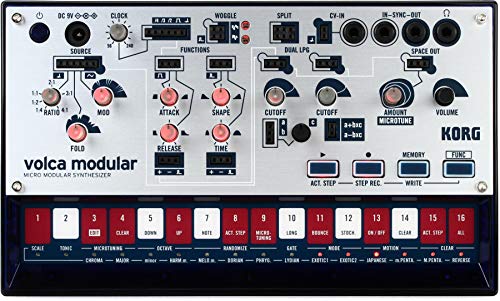
- Eight independent modules
- 50 patch points for routing
- Built-in 16-step sequencer
Best For: Portable experimental patching and West Coast-style synthesis
Classic Analog Starter
Behringer CRAVE Semi-Modular Synth

- Pure analog signal path
- 24 dB ladder filter with resonance
- 32-step sequencer and poly chain
Best For: Classic analog tone with sequencer-driven patching
Percussion Patch Specialist
Moog DFAM Analog Percussion Synthesizer

- Two analog VCOs and white noise
- 24-point patch bay
- 8-step sequencer and Eurorack format
Best For: Experimental analog percussion and modular expansion
Compact Semi-Modular Analog Pick
Behringer K-2 MK II Semi-modular Analog Synthesizer

- Dual VCOs with oscillator sync
- External audio input for routing
- Supports 16-voice poly chain
Best For: Players who want a compact analog module for patching and expansion
Polyrhythmic Experimental Choice
MOOG Subharmonicon Semi-Modular Polyrhythmic Synthesizer

- Six tonal sources for dense harmony
- Dual sequencers with four rhythm generators
- Tabletop synth or 60HP Eurorack module
Best For: Experimental musicians focused on polyrhythms and evolving harmonic textures
Compact Build-It-Yourself Option
MOOG Mavis Semi-Modular Analog Synthesizer

- 100% analog build-it-yourself kit
- Built-in keyboard with glide and scaling
- 44HP Eurorack-compatible module
Best For: Beginners who want a compact Moog kit with keyboard control and patching
Classic Moog Workhorse
Grandmother Semi-Modular Analog Synthesizer

- 32-key playable semi-modular Moog design
- 256-note sequencer plus arpeggiator
- 41 patch points and spring reverb
Best For: Players who want a hands-on Moog semi-modular synth with built-in keys and reverb
Compact Acid Yellow Starter
CRAVE Analog Semi-Modular Synthesizer

- Pure analog signal path with 3340 VCO
- Classic ladder filter with low/high pass mode
- 32-step sequencer and 16-voice poly chain
Best For: Budget-conscious users who want a compact analog semi-modular synth
Eurorack Ready Classic
Mother-32 Semi-Modular Analog Synthesizer

- Analog Moog voice with ladder filter
- 32-note sequencer with up to 64 sequences
- Tabletop synth or 60HP Eurorack module
Best For: Synth players who want a tabletop Moog that can also slot into a Eurorack system
Portable West Coast Explorer – Korg Volca Modular Micro Synthesizer
If you want a semi modular synthesizer system that is easy to carry and quick to patch, the Korg Volca Modular is built for hands-on sound design. It pairs eight independent modules with 50 patch points, so you can experiment with routing and discover unusual textures without needing a large setup.
Best For: Players who want a compact, battery-ready semi modular synth for experimental sounds and portable sequencing.
Pros:
- Eight independent modules support flexible sound creation
- 50 patch points allow extensive signal routing and experimentation
- Built-in 16-step sequencer with two playback modes and a randomize function
- Compact design with built-in speaker for immediate use
Cons:
- No external controller or expanded performance setup is included
- Small format may feel limited if you want a larger synth panel
Overall, this is a strong pick if you value portability and creative patching over a bigger desktop instrument. It is especially appealing for West Coast-style synthesis exploration and quick idea capture.
Classic Analog Starter – Behringer CRAVE Semi-Modular Synth
The Behringer CRAVE is a semi modular synthesizer system aimed at players who want classic analog tone in a compact format. Its pure analog signal path, 3340 VCO, and 24 dB ladder filter give it a familiar subtractive-synth foundation, while the patchable design opens the door to more adventurous routing.
Best For: Musicians who want an affordable analog semi modular synth with a classic filter sound and step sequencing.
Pros:
- Pure analog signal path with authentic VCO, VCF, and VCA designs
- Classic Moog-style 24 dB ladder filter with resonance
- 32-step sequencer supports pattern building and performance ideas
- 16-voice poly chain adds expansion potential
Cons:
- Compact control layout may feel tight for users wanting more hands-on space
- Patch-focused workflow may take time to learn if you are new to semi modular gear
In practical terms, the CRAVE is a straightforward way to get into semi modular analog synthesis without giving up classic filter character. It suits players who want a simple starting point with room to grow.
Hybrid Rhythm Lab – Behringer Grind Semi-Modular Synth
The Behringer Grind is a semi modular synthesizer system built around a hybrid, multi-engine approach. With 24 digital oscillators, 10 percussion/noise engines, an analog ladder filter, and a 32-step sequencer, it is designed for users who want a broad palette for rhythm-heavy sound creation.
Best For: Sound designers and beat-focused players who want a hybrid semi modular synth with lots of engine variety.
Pros:
- Hybrid design combines digital oscillator engines with an analog ladder filter
- 24 digital oscillators and 10 percussion/noise engines expand sound variety
- 32-step sequencer supports pattern-based creation
- MIDI connectivity makes it easier to integrate into larger setups
Cons:
- Hybrid architecture may be more specialized than a simple analog-only synth
- Larger footprint may be less convenient than ultra-compact tabletop units
For users who want more than a basic analog voice, the Grind offers a lot of synthesis material in one instrument. It is a sensible choice if your semi modular synthesizer system needs layered textures, percussion, and sequencing.
Percussion Patch Specialist – Moog DFAM Analog Percussion Synthesizer
The Moog DFAM is a semi modular synthesizer system focused on percussion and rhythmic experimentation. It uses two analog VCOs, a white noise generator, and the Moog ladder filter, plus an 8-step sequencer and a 24-point patch bay for direct hands-on exploration.
Best For: Musicians who want an analog percussion synth for experimental rhythms and Eurorack-compatible setups.
Pros:
- Fully analog voice with two VCOs, white noise, and Moog ladder filter
- 24-point patch bay supports flexible modular routing
- 8-step sequencer encourages immediate rhythmic creation
- Can be used tabletop or installed as a 60HP Eurorack module
Cons:
- Centered on percussion and rhythms rather than traditional keyboard-style synthesis
- Short 8-step sequencer may feel limiting for longer patterns
If your goal is to build unique drum-like textures and evolving rhythmic phrases, the DFAM is one of the most focused options here. It also expands naturally with other Moog semi modular instruments.
Compact Semi-Modular Analog Pick – Behringer K-2 MK II Semi-modular Analog Synthesizer
If you want a semi modular synthesizer system with a straightforward analog core, the Behringer K-2 MK II is built around dual VCOs, oscillator sync, and external audio input for hands-on patching and sound shaping. It is a practical choice if you want a compact module that can sit in a larger setup or work as a focused standalone synth.
Best For: Players who want an analog semi-modular module with dual oscillators and easy integration into a bigger rig.
Pros:
- Semi-modular analog design for flexible patching
- Dual VCOs with oscillator sync
- External audio input adds routing options
- Supports 16-voice poly chain
Cons:
- No built-in keyboard listed
- More focused on module-style use than all-in-one control
Overall, the K-2 MK II is a good fit if you want a no-frills analog entry point into semi modular synthesizer system workflows. Its feature set emphasizes core synthesis and expansion rather than extras, which makes it easy to place in a growing studio.
Polyrhythmic Experimental Choice – MOOG Subharmonicon Semi-Modular Polyrhythmic Synthesizer
The MOOG Subharmonicon is a semi modular synthesizer system aimed at rhythmic experimentation, with six tonal sources, dual sequencers, and four rhythm generators. It can be used as a tabletop synth or installed as a 60HP Eurorack module, giving you two practical ways to fit it into a performance or studio rig.
Best For: Musicians who want polyrhythms, complex harmonic textures, and a synth that can expand with other Moog instruments.
Pros:
- Six tonal sources for dense harmonic sound
- Dual four-step sequencers and four rhythm generators
- Tabletop use or 60HP Eurorack installation
- Designed to expand with other Moog instruments
Cons:
- Specialized design is less conventional than a standard synth
- Plastic body rather than metal construction
If you want a semi modular synthesizer system that leans into unusual rhythm and harmony, the Subharmonicon stands out immediately. It is especially appealing for players who want a rich, complex sound profile and a layout built for experimentation.
Compact Build-It-Yourself Option – MOOG Mavis Semi-Modular Analog Synthesizer
The MOOG Mavis is a compact semi modular synthesizer system that combines a 100% analog design with a build-it-yourself kit and a built-in keyboard. It includes an oscillator, ladder filter, ADSR, wavefolder, sample and hold, attenuators, and mults, so it is a practical way to explore patching in a very small footprint.
Best For: Beginners and hands-on users who want a compact Moog semi-modular synth kit with Eurorack compatibility.
Pros:
- 100% analog design with Moog oscillator and filter circuits
- Includes a built-in keyboard with glide and keyboard scaling
- Compact 44HP module with Eurorack integration
- Kit includes patch cables, tools, and dust cover
Cons:
- Assembly is required
- Compact layout may feel limited compared with larger systems
Mavis is a strong option if you want a semi modular synthesizer system that teaches patching without taking up much space. Its included kit components and built-in keyboard make it especially approachable for a smaller home setup or desktop rig.
Classic Moog Workhorse – Grandmother Semi-Modular Analog Synthesizer
If you want a semi modular synthesizer system that feels immediate but still leaves room to explore, the Moog Grandmother is a strong pick. It pairs a playable 32-key format with built-in sequencing, arpeggiation, and a spring reverb tank, so you can start making complete patches without relying on extra gear.
Best For: Players who want a hands-on Moog semi-modular synth with built-in keys, sequencing, and classic spring reverb.
Pros:
- 32 velocity-sensitive full-size keys make it easy to perform and sketch ideas.
- Built-in arpeggiator and 256-note sequencer add fast, standalone workflow options.
- 41 modular patch points give you plenty of room for deeper routing and experimentation.
- Hardware spring reverb can also process external sounds for extra flexibility.
Cons:
- Monophonic design is limiting if you need chords.
- At 7.25 kg, it is a fairly substantial desktop instrument.
The Grandmother is best viewed as a playable centerpiece for a semi modular synthesizer system, especially if you value classic Moog character and a self-contained creative setup. Its balance of performance controls and patchability makes it easy to grow with.
Compact Acid Yellow Starter – CRAVE Analog Semi-Modular Synthesizer
The Behringer CRAVE is a compact semi modular synthesizer system option for buyers who want a pure analog signal path in a small footprint. With its 3340 VCO, classic ladder filter, and built-in 32-step sequencer, it is geared toward immediate sound design and pattern building.
Best For: Budget-conscious users who want a compact analog semi-modular synth with classic filter character and sequencing.
Pros:
- Pure analog signal path with VCO, VCF, and VCA designs.
- 3340 oscillator and pulse/saw outputs support fat, flexible tones.
- Classic 24 dB ladder filter with switchable low/high pass mode expands sound shaping.
- 32-step sequencer and 16-voice poly chain increase musical usefulness.
Cons:
- No keyboard is included, so performance may require external control.
- The included components are minimal compared with more complete desktop synth packages.
CRAVE is a practical entry point if you want analog tone and patchable workflow without a large or expensive setup. Its small size and sequencing features make it especially appealing for tight studio spaces or modular-friendly rigs.
Eurorack Ready Classic – Mother-32 Semi-Modular Analog Synthesizer
The Moog Mother-32 is a focused semi modular synthesizer system built for raw analog tones, quick sketching, and Eurorack expansion. It delivers a classic ladder filter, a 32-note step sequencer, and a patchbay that makes it easy to move between self-contained use and deeper modular setups.
Best For: Synth players who want a tabletop Moog that can also slot into a Eurorack system.
Pros:
- Analog signal path with oscillator, white noise generator, and Moog ladder filter.
- 32-note step sequencer supports two modes and up to 64 onboard sequences.
- Can be used as a tabletop synth or installed as a 60HP Eurorack module.
- Extended patchbay and included patch cables encourage modular exploration.
Cons:
- Monophonic design means it is not suited to playing chords directly.
- Compact, focused layout may feel limited if you want a larger all-in-one workstation.
If your goal is to build a semi modular synthesizer system around a proven Moog voice, the Mother-32 is one of the most straightforward choices. It is especially appealing for users who want a compact synth now and an Eurorack module later.
How We Picked These Semi Modular Synthesizer System Options
We prioritized instruments that offer a useful core voice, real patching flexibility, and enough built-in controls to play creatively right away. We also considered sound character, sequencing tools, MIDI integration, expandability, and whether the design makes sense for beginners or more advanced users.
Quick Comparison: What Matters Most
Not every Semi Modular Synthesizer System serves the same purpose. Some are compact and experimental, while others are performance-ready keyboards or utility-focused desktop voices. The best choice depends on whether you want a first synth, a percussion source, a bass and lead machine, or a compact modular companion.
Key Buying Factors for a Semi Modular Synthesizer System
Patching Depth
Look at the number and usefulness of patch points. More jacks do not always mean better, but they do increase routing options, modulation variety, and long-term creative potential.
Built-In Sound Engine
Check whether the instrument offers one voice, a hybrid engine, or a percussion-focused design. A strong internal architecture matters because you should still be able to make useful sounds without external gear.
Sequencing and Performance Tools
Step sequencers, arpeggiators, and MIDI support can dramatically improve workflow. If you plan to jam or perform live, these features may matter as much as the patch bay.
Form Factor and Integration
Some models are ideal for desktop rigs and Eurorack-style expansion, while others are better as standalone instruments with keys and a full front panel. Make sure the size and connectivity fit your studio space and existing setup.
Who Should Buy Which Semi Modular Synthesizer System?
Beginners usually benefit from simpler, more self-contained designs that teach synthesis through immediate hands-on control. Producers who want basses, sequences, and modular-style modulation should look for a versatile all-rounder. Experimental musicians may prefer more unusual voices or polyrhythmic and percussion-oriented models. If you already own modular gear, choose the option that adds the missing function rather than the biggest feature list.
For most shoppers, the best Semi Modular Synthesizer System is the one that encourages actual use: easy enough to start fast, but open enough to stay interesting as your patching skills grow.