Standalone samplers give you a focused way to capture, shape, sequence, and perform sounds without relying on a computer. The right model can become the center of a portable beatmaking setup, a live rig, or a fast sketchpad for new ideas.
This roundup compares 10 notable options, from compact grooveboxes and portable samplers to performance-focused workstations with deeper sequencing, effects, and controller features.
Best 10 Standalone Samplers Picks for 2026
All-in-One Powerhouse

- Standalone production with sampling, synthesis, and sequencing
- 16 velocity-sensitive RGB pads and 7-inch touchscreen
- Wi-Fi, Bluetooth MIDI, CV/Gate, and extensive I/O
Best For: Producers seeking a full-featured standalone workstation
Portable Groove Builder

- Records and reshapes samples from phones, turntables, and synths
- Eight sample tracks with chainable 32-step patterns
- Battery-powered design with live performance effects
Best For: Hands-on beat making and portable live performance
Tracker Workflow
- Portable standalone tracker-style audio workstation
- 4,000 preloaded samples included
- Wavetable and granular synthesis support
Best For: Tracker enthusiasts and portable sample-based composition
Live Effects Performer

- Standalone sampler designed for DJ and live performance
- 5-inch touchscreen with 16 velocity-compatible pads
- Real-time effects, cueing, beatmatching, and dual faders
Best For: DJs and performers triggering clips and effects live
Best All-in-One Groovebox
Polyend Play+ Standalone Sampler
- 16 stereo tracks and backlit performance pads
- 5,000+ onboard samples with microSD support
- USB, headphone output, and Ableton Live support
Best For: Producers seeking a sampler, sequencer, and synth in one unit
Best Portable Value
- 8-voice sample-based drum machine
- 16-step sequencing with pattern chaining
- Battery-powered with speaker and headphone output
Best For: Portable beatmaking and compact standalone setups
Best for DJ Performance
Pioneer DJ DJS-1000 Standalone Sampler

- 16 velocity-sensitive pads and 7-inch touchscreen
- Standalone sampling and live step sequencing
- PRO DJ LINK synchronization with CDJs and DJM mixers
Best For: DJs adding hands-on samples and remixes to live sets
Best Portable MPC Sampler

- Portable, battery-powered MPC workflow
- Built-in mic, speaker, pads, and sequencing
- Sampling, chopping, resampling, and onboard FX
Best For: Beginners and mobile beatmakers
Best Performance-Focused Sampler

- Battery-powered sampling with built-in microphone
- 29 DSP effects for live sound shaping
- Pads, sequencer, quantize, shuffle, and Sub Pad
Best For: Live sample-based performance
Best Bundle for Beatmaking

- Eight sample tracks for layered beats
- Slice, sculpt, resample, and add performance FX
- Includes headphones, 32GB card, and MIDI cables
Best For: Beatmakers wanting an accessory-ready setup
All-in-One Powerhouse – Akai MPC One+
The Akai MPC One+ is one of the most fully featured standalone samplers for producers who want sampling, sequencing, synthesis, and beat-making without a computer. Its velocity-sensitive pads, touchscreen workflow, wireless connectivity, and broad I/O make it suitable for both studio production and hardware-based setups.
Best For: Producers who want a comprehensive standalone workstation with deep sequencing, synth engines, effects, and computer connectivity.
Pros:
- Works without a computer and includes 16 velocity- and pressure-sensitive RGB pads.
- Offers 128 MIDI tracks and 8 audio tracks per project, plus built-in synth engines and AIR effects.
- Includes Wi-Fi, Bluetooth MIDI, MIDI I/O, CV/Gate outputs, audio inputs, and USB connectivity.
Cons:
- Its extensive feature set may take time to learn.
- It is less compact than simpler portable samplers.
The MPC One+ is a strong choice when you want standalone sampling alongside serious arrangement, mixing, synthesis, and expansion options. It is especially appealing if you expect your sampler to serve as the center of a larger hardware rig.
Portable Groove Builder – Novation Circuit Rhythm
The Novation Circuit Rhythm is a focused standalone sampler and groovebox for quickly turning recorded sounds into beats. It can capture audio from sources such as a phone, turntable, or synth, then lets you slice, reverse, loop, resample, and sequence those sounds across eight sample tracks.
Best For: Beat makers and live performers who prioritize hands-on sampling, pattern-based sequencing, and portability.
Pros:
- Records directly from external sources and supports slicing, reversing, looping, and resampling.
- Eight sample tracks include 32-step patterns that can chain to 256 steps per track.
- Includes performance effects, sidechain, MIDI connectivity, and a stated four-hour battery life.
Cons:
- Its eight-track design is more focused than larger production workstations.
- The plastic body may feel less substantial than metal-bodied alternatives.
Circuit Rhythm is a practical option for immediate beat creation and sample manipulation. Its streamlined layout and battery operation make it particularly useful for sketching ideas away from a computer or adding hands-on control to live sets.
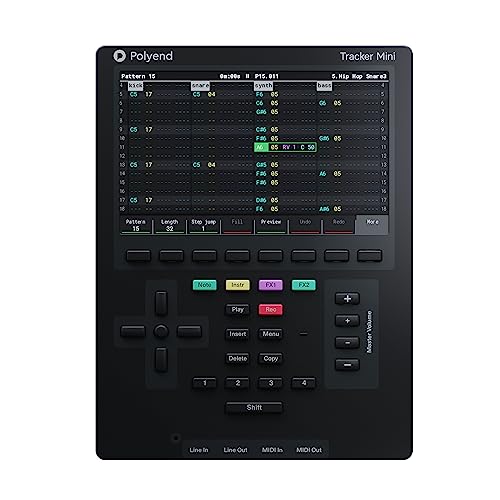
Tracker Workflow – Polyend Tracker Mini
The Polyend Tracker Mini is a portable standalone audio workstation sampler built around a tracker-style workflow. With 4,000 preloaded samples, microSD support, wavetable synthesis, and granular synthesis, it offers a compact way to build detailed arrangements without relying on a computer.
Best For: Producers who enjoy tracker-based sequencing and want a portable sampler with synthesis options.
Pros:
- Includes 4,000 preloaded samples for immediate sound exploration.
- Supports wavetable and granular synthesis in a standalone format.
- Portable design with microSD support and a supplied microSD-to-USB-A adapter.
Cons:
- The tracker workflow may be less familiar than pad- or touchscreen-based sequencing.
- The supplied notes provide limited information about audio inputs and outputs.
The Tracker Mini stands out among standalone samplers for its compact tracker approach and built-in synthesis capabilities. It is a good fit for users who value sample-based composition, portability, and an unconventional sequencing workflow.
Live Effects Performer – Korg KAOSS Replay
The Korg KAOSS Replay combines standalone sampling with performance-oriented effects and DJ-style controls. Its 5-inch capacitive touchscreen, 16 velocity-compatible pads, dual channel faders, and beatmatching controls make it one of the more performance-focused standalone samplers in this group.
Best For: DJs and live performers who want clip triggering, real-time effects, and hands-on track mixing.
Pros:
- Operates independently and is designed for live performances and DJ sets.
- Provides real-time vocal effects, delays, reverbs, pitch shifting, and distortion.
- Combines 16 trigger pads with a large touchscreen, A/B selection, cue controls, and dual faders.
Cons:
- Its feature emphasis is live performance and effects rather than broad workstation-style production.
- At approximately 2 kg, it is less lightweight than some portable samplers.
The KAOSS Replay is best viewed as a performance sampler and effects hub. If your priority is manipulating clips, applying effects, and mixing tracks in real time, its DJ-style layout offers a direct and practical control scheme.
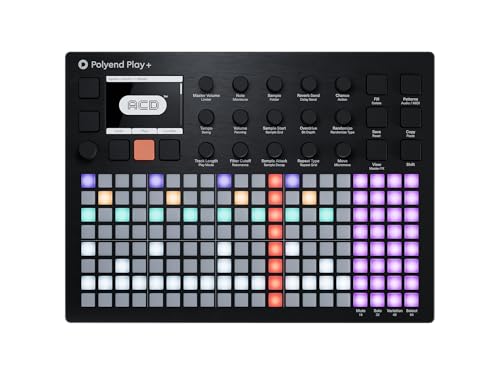
Best All-in-One Groovebox – Polyend Play+ Standalone Sampler
The Polyend Play+ combines sampling, synthesis, sequencing, and MIDI workstation functions in a standalone format. For shoppers comparing standalone samplers, its 16 stereo tracks, performance pads, onboard sample library, and microSD support make it a flexible choice for hands-on beatmaking without relying exclusively on a computer.
Best For: Performers and producers who want a feature-rich groovebox with extensive onboard samples and pad-based control.
Pros:
- Provides 16 stereo tracks for arranging samples and parts.
- Includes backlit performance pads for tactile control.
- Offers 5,000+ onboard samples plus a 16GB microSD card and expansion slot.
- Includes USB connectivity, headphone output, and Ableton Live support.
Cons:
- Its broad groovebox and workstation feature set may be more than needed for simple sample playback.
- The supplied notes do not specify battery-powered operation.
Choose the Play+ if you want standalone sampling alongside synthesis, sequencing, and MIDI-focused workflow tools. Its larger sample storage and 16-track design suit users who expect to build complete arrangements rather than trigger a few samples.
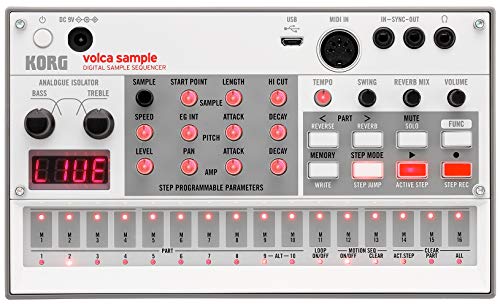
Best Portable Value – Korg Volca Sample 2
Korg Volca Sample 2 Digital Sample Sequencer Drum Machine w/Pattern Chain Mode and 16-step Sequencer
Check Price On AmazonThe Korg Volca Sample 2 is a compact digital sample sequencer and drum machine designed for quick pattern creation. Among standalone samplers, it stands out for its lightweight body, integrated speaker, headphone output, battery operation, and practical pattern-chain features.
Best For: Mobile beatmakers and beginners who want a lightweight, battery-powered sampler for drum patterns and compact live setups.
Pros:
- Includes an 8-voice polyphonic sample-based drum engine.
- Offers a 16-step sequencer with pattern chaining and start delay.
- Provides double the memory of the previous model for more samples and longer recordings.
- Runs on six AA batteries or an AC adapter and includes a speaker and headphone output.
Cons:
- Its compact 16-step workflow is less suited to users wanting a larger arrangement interface.
- Computer connectivity uses micro USB, and sample management relies on dedicated Librarian software.
The Volca Sample 2 is a sensible pick when portability and straightforward sequencing matter more than workstation-level depth. Pattern chaining, effects, and flexible power options give it useful range for genres including future bass, trap, and lo-fi hip hop.
Best for DJ Performance – Pioneer DJ DJS-1000 Standalone Sampler
The Pioneer DJ DJS-1000 is a performance-focused standalone DJ sampler and sequencer built for live, hands-on use. For DJs comparing standalone samplers, its 16 velocity-sensitive pads, 7-inch touchscreen, step sequencer, and PRO DJ LINK integration make it especially suited to adding samples and live remixes to a booth setup.
Best For: DJs who want laptop-free sample triggering, pattern creation, and tempo-synced integration with compatible Pioneer DJ equipment.
Pros:
- Works as a standalone sampler and sequencer for live DJ sets.
- Combines 16 velocity-sensitive pads with a 7-inch touchscreen.
- Supports step sequencing for building drum patterns and loops on the fly.
- PRO DJ LINK can synchronize it with CDJs and DJM mixers.
Cons:
- At 15 pounds, it is considerably less portable than compact samplers such as the Volca Sample 2.
- Its DJ-oriented workflow may be excessive for users seeking a small basic drum sampler.
- The supplied notes list RCA, TRS, USB, and XLR connectivity but do not detail battery runtime.
The DJS-1000 makes the most sense when live DJ integration and tactile performance are priorities. Its touchscreen, velocity-sensitive pads, and booth-focused synchronization tools favor performers who want to manipulate samples and loops as part of a larger DJ system.
Best Portable MPC Sampler – MPC Sample
The Akai Professional MPC Sample is one of the most approachable standalone samplers for beatmakers who want the familiar MPC workflow without a computer. Its rechargeable battery, built-in speaker, microphone, pads, sequencing, effects, and microSD storage support portable sampling and DAWless production.
Best For: Beginners, finger drummers, beatmakers, and producers seeking a compact all-in-one sampler for mobile or DAWless work.
Pros:
- Battery-powered design with built-in speaker and microphone enables sampling and playback away from a computer.
- 16 MPC pads, sample chopping, real-time timestretching, repitching, and internal resampling create a fast beatmaking workflow.
- Includes four internal FX processors, 60 effect types, factory kits, USB-C audio/MIDI, and useful studio and live I/O.
Cons:
- MIDI DIN connectivity requires a separate 1/8-inch-to-DIN adapter.
- The compact 2.4-inch display may feel limited for users who prefer larger visual interfaces.
Choose the MPC Sample if portability and an easy entry into MPC-style sampling matter most. It offers a particularly complete standalone setup, though users needing extensive screen-based editing may prefer a larger device.
Best Performance-Focused Sampler – Roland SP-404A
The Roland SP-404A is a performance-oriented choice among standalone samplers, pairing battery operation and a built-in microphone with hands-on pads, effects, and sequencing. Its compact control layout is suited to triggering samples and shaping live sets without relying on a computer.
Best For: Live performers, sample-based producers, and AIRA users who want tactile effects and quick sample triggering.
Pros:
- Built-in microphone and battery power support sampling in portable settings.
- Twenty-nine DSP effects include filters, delay, voice effects, subsonic processing, and a looper.
- Twelve trigger pads, a Sub Pad, pattern sequencer, quantize, shuffle, and seamless effect switching support live performance.
- Includes an SD card with more than 100 stereo samples, effects, and one-shots.
Cons:
- Importing audio and assigning samples to pads requires the free Mac or Windows software.
- The listed control layout uses 12 trigger pads rather than the 16-pad arrangement found on some competing samplers.
The SP-404A is a strong fit when performance controls and effects are higher priorities than an expansive production interface. It is especially appealing for performers who want quick triggering, resampling, and expressive transitions.
Best Bundle for Beatmaking – Circuit Rhythm Sampler Bundle
The Novation Circuit Rhythm bundle combines a standalone sampler and groovebox with monitor headphones, a 32GB memory card, and two MIDI cables. It is designed for making and performing beats by recording samples, slicing and sculpting them, then building layers across eight sample tracks.
Best For: Beatmakers and performers who want a ready-to-use standalone sampler bundle with storage and monitoring accessories.
Pros:
- Records samples directly, then supports slicing, sculpting, and resampling.
- Eight sample tracks provide room for layered beat arrangements.
- Quantized or off-grid grooves and performance FX support both structured production and live sets.
- Bundle includes Studio Professional Monitor Headphones, a 32GB microSD card, and two MIDI cables.
Cons:
- The supplied notes identify USB-C connectivity but do not list built-in speakers, microphones, or battery operation.
- The bundle’s included headphones and accessories may be less useful to buyers who already own studio essentials.
The Circuit Rhythm bundle is a practical pick for users who want to start making beats immediately and value included accessories. Its eight-track sampling layout and performance FX make it well suited to groove-focused production and live use.
How We Picked These Standalone Samplers
We selected these Standalone Samplers based on workflow, sampling flexibility, sequencing tools, performance controls, portability, connectivity, and the type of musician each device best serves. The list includes compact entry-level units, full-featured production workstations, DJ-oriented samplers, and grooveboxes that combine sampling with synthesis or effects.
Because “standalone” can mean different things across product categories, we considered whether each device can support meaningful music-making without a computer, while also noting where a computer, memory card, or external gear may improve the experience.
Quick Comparison
| Best For | Look For |
|---|---|
| All-in-one beat production | MPC-style sequencing, pads, plug-ins, and broad connectivity |
| Portable groovebox performance | Battery-friendly design, pattern sequencing, and immediate controls |
| Live effects and resampling | Performance pads, hands-on effects, and fast sample manipulation |
| DJ sampling | Large pads, touchscreen control, beat matching, and performance features |
| Compact sample sequencing | Simple operation, pattern chaining, and a small physical footprint |
| Advanced hybrid production | Deeper synthesis, MIDI control, sampling, and arrangement tools |
Key Buying Factors for Standalone Samplers
Sampling and Storage
Check how samples are imported, recorded, edited, and stored. Internal memory may be convenient, while removable storage offers easier library management. Also confirm supported file formats, sample time, and whether the workflow is designed for one-shots, loops, instruments, or live resampling.
Sequencing and Arrangement
Pattern-based sequencers are excellent for improvisation and loop-driven music, while linear timelines are better for building complete arrangements. If you make evolving tracks, look for automation, pattern chaining, song modes, and flexible MIDI sequencing.
Controls and Performance
Velocity-sensitive pads, knobs, faders, touchscreens, and dedicated effects controls can make a major difference on stage. Consider whether the layout supports quick edits without menus and whether the device responds well to finger drumming or live sample triggering.
Connectivity and Expansion
Review the available audio inputs and outputs, MIDI connections, USB options, and wireless features. Some units work well as the hub of a larger studio, while others are primarily self-contained performance instruments. Headphone output, external storage, and synchronization support are also worth checking.
Portability and Learning Curve
A compact sampler is easier to carry and may encourage spontaneous music-making, but smaller controls can require more menu navigation. Larger workstations generally offer more depth and visibility at the cost of space and weight.
Who Should Buy Which Standalone Samplers?
Choose an MPC-style workstation if you want one central device for beatmaking, sequencing, sampling, and MIDI control. Pick a compact groovebox if portability and immediate pattern-based performance matter most. A performance sampler with strong effects is a better fit for live manipulation, transitions, and resampling.
DJ performers should prioritize touchscreen control, beat-focused features, and large trigger pads. Producers who want a small, affordable entry point may prefer a straightforward sample sequencer, while experienced electronic musicians may benefit from a hybrid unit that combines sampling, synthesis, deeper sequencing, and external MIDI control.
Before buying, match the instrument’s workflow to the way you actually create. The most capable device is not always the best choice; the ideal standalone sampler is the one whose controls, storage, connectivity, and sequencing style help you finish ideas quickly.