The KLIQ UberTuner clip on guitar tuner is for players who want quick, vibration-based tuning without relying on a noisy room or a mic.
If you need a compact tuner that covers several instruments, this KLIQ UberTuner review focuses on what it does well and where the compromises are.
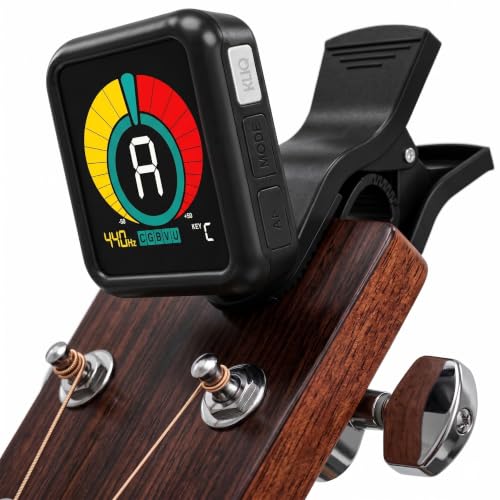
KLIQ UberTuner Review Summary
The KLIQ UberTuner is a good fit for players who value speed, simplicity, and broad instrument support over extra features.
It is especially appealing if you move between acoustic guitar, electric guitar, bass, ukulele, violin, banjo, or other chromatic instruments and want a tuner that clips on, reads vibration, and gets out of the way.
Its strongest selling point is the combination of a chromatic tuning mode, a vibration-based sensor, and a rotating color display.
That makes it practical in rehearsal spaces, on stage, and in home setups where microphone tuners can be less dependable.
The tradeoff is that this is a utility-first tool, not a flashy multi-effect accessory.
Buyers who want a straightforward tuning aid should be satisfied; buyers looking for app-like polish or deep customization may want something else.
Review Scorecard
| Category | Score | Why it earns that score |
|---|---|---|
| Tuning speed | 9/10 | The listing emphasizes fast pitch detection with a piezo sensor and processor designed for quick response. |
| Accuracy potential | 9/10 | The product claims accuracy within 1 cent, which is strong for a clip-on tuner in this class. |
| Instrument flexibility | 10/10 | It supports guitar, bass, violin, ukulele, mandolin, banjo, and chromatic use. |
| Noise resistance | 10/10 | Vibration-based tuning avoids relying on ambient sound, which is useful in loud rooms. |
| Display usability | 8/10 | The 360-degree rotating color screen should help visibility from more than one angle. |
| Build and fit | 8/10 | The padded clip is designed to grip firmly while protecting the finish, which matters on frequent use. |
| Everyday convenience | 9/10 | It is compact, battery-powered, and includes the essentials without extra setup. |
Key Features and Specifications of KLIQ UberTuner
The KLIQ UberTuner is a black clip-on chromatic tuner with a focus on portability and broad compatibility.
The listing highlights a professional-grade piezo sensor, a fast processor, and vibration-based pitch detection, so the tuner is meant to read the instrument directly rather than listen through the air.
Important product facts from the listing:
| Feature | Detail |
|---|---|
| Brand | KLIQ |
| Product type | Clip-on chromatic tuner |
| Color | Black |
| Main use | Acoustic guitar, electric guitar, bass, ukulele, violin, banjo, and other instruments |
| Display | Full-color LED screen with 360-degree rotation |
| Detection method | Vibration-based, no microphone required |
| Claimed accuracy | Within 1 cent |
| Calibration range | 430-450 Hz |
| Transposition modes | Bb, Eb, F, D |
| Power | Included CR2032 battery |
The broad mode support is useful because it lets the same tuner move between common stringed instruments without friction.
The calibration and transposition features add flexibility for players who work with nonstandard reference pitches or brass and woodwind transpositions, though that will matter more to some musicians than others.
The padded clip is another practical detail.
Clip-on tuners can be annoying if they feel flimsy or leave marks, so a padded grip is a meaningful buy decision factor even if it is easy to overlook from the product title alone.
Pros and Cons of KLIQ UberTuner
Pros
- Works in noisy places. Because it listens for vibration instead of sound, it should be more dependable than mic-based tuners in rehearsal or live settings.
- Fits many instruments. Guitar, bass, violin, ukulele, banjo, mandolin, and chromatic tuning all appear in the listing.
- Easy to read. The rotating color display is a practical advantage for left-handed players, odd headstock shapes, and awkward mounting angles.
- Simple to carry. It is small, clip-based, and battery-powered, which makes it easy to keep in a gig bag or case.
- Finish-conscious clip design. The padded grip suggests the tuner is intended for regular attachment without being hard on the instrument.
Cons
- Not a premium feature set. It is built as a utility tuner, so buyers expecting deep app integration or a high-end interface may feel underwhelmed.
- Best for direct instrument attachment. If you prefer tuning from a phone or desk-based workflow, the clip-on format may feel unnecessary.
- Some features matter only to certain players. Calibration and transposition are useful, but not every guitarist will use them regularly.
The pros are practical rather than glamorous.
That is a strength if you need a reliable tuner that solves a specific problem quickly.
It is a weakness only if you want the product to double as a more advanced practice tool.
Who Should Buy KLIQ UberTuner?
This tuner makes sense for players who want a fast, no-drama clip-on solution.
It is a strong match for beginners who need a simple first tuner, teachers who want one device that works across multiple student instruments, and gigging players who need something that still works when the room is loud.
It is also a good fit for anyone who switches between instruments.
The listing support for guitar, bass, ukulele, violin, banjo, and mandolin means the same tuner can stay useful across a whole household or studio.
You should probably skip it if you want a tuner that is more about software features than hardware convenience.
If your setup is always quiet and you prefer a phone app or pedal tuner, the clip-on format may not be the best value for you.
Tuning Performance and Daily Use
Vibration-Based Detection
The most important practical feature here is the piezo-based detection system.
In real use, that matters because the tuner is not trying to interpret room noise, drums, amp spill, or voices.
For players who tune backstage, between songs, or in a shared practice room, that design choice is what makes the product useful.
Display Angle and Readability
The 360-degree adjustable color display is a small feature that can make a large difference.
Clip-on tuners become frustrating when the screen is hard to see from a playing position, and the ability to rotate the display helps with right-handed and left-handed use alike.
That makes the tuner feel more adaptable than cheaper fixed-angle designs.
Multi-Instrument Coverage
The broad instrument list is one of the clearest reasons to consider the UberTuner.
A player who only owns one guitar might not care much, but households, teachers, and multi-instrument players often need a single device that can move from guitar to bass to ukulele without requiring a separate tuner for each one.
Portability and Power
The included CR2032 battery keeps the setup simple.
There is no app pairing, charging cable, or extra gear to manage.
For a utility product, that matters: you want a tuner that can sit in a case for weeks and still be ready when you need it.
Alternatives to KLIQ UberTuner
If you want a different clip-on tuner experience, these are credible Amazon search alternatives to compare:
Snark is the obvious comparison if you want a familiar clip-on tuner brand with broad musician recognition.
D’Addario and Fender are worth checking if you prefer established accessory brands.
TC Electronic is more relevant if you want to step toward a pedal-based tuning workflow instead of a headstock clip.
Is KLIQ UberTuner Worth It?
Yes, if you want a simple, portable, noise-resistant tuner that covers multiple instruments and does not waste time on unnecessary extras.
The KLIQ UberTuner is most convincing as a dependable everyday tool for guitarists and multi-instrument players who value speed, visibility, and flexibility.
If your needs are basic, this looks like a sensible buy.
If you want more advanced workflow integration or a non-clip format, compare it against pedal or app-based alternatives before deciding.