If you want a more tactile, efficient way to mix, a control surface with touch sensitive faders can speed up editing, automation, and level riding without constant mouse use.
Below, we focus on the best options for home studios, project rooms, and pro DAW setups, with choices for different channel counts, software ecosystems, and control styles.
Best 10 Control Surface with Touch Sensitive Faders Picks for 2026
Universal DAW Remote
Behringer X-TOUCH Universal Control Surface

- 9 touch-sensitive 100 mm motor faders
- 8 LCD scribble strips for track labels
- USB, Ethernet, and MIDI connectivity
Best For: Versatile DAW control with clear track feedback
Compact Multi-Fader Mixer
PreSonus FaderPort 16 DAW Controller

- 16 touch-sensitive motorized faders
- 16 scribble strips and deep session control
- Compatible with major Mac and Windows DAWs
Best For: Desk-friendly multi-fader mixing and editing
Single-Fader DAW Control
Behringer X-TOUCH ONE Universal Control Surface

- One touch-sensitive motor fader
- LCD scribble strip and lighted buttons
- HUI and Mackie Control support
Best For: Portable hands-on control for essential DAW tasks
Protected 16-Channel Controller
PreSonus FaderPort 16 with Decksaver Cover

- 16 touch-sensitive motorized faders
- Includes Decksaver polycarbonate cover
- 16 scribble strips and session controls
Best For: Studio users who want protection bundled in
Compact Touch-Driven DAW Control

- 9 touch-sensitive 100 mm motorized faders
- Mackie Control emulation for compatible DAWs
- Dual-layer mode for DAW and instrument control
Best For: compact DAW users who want tactile, pre-configured fader control
Portable Wireless Fader Control

- 8 faders with backlit switches
- Bluetooth and USB connectivity
- Compact, lightweight design for mobile use
Best For: mobile producers needing a portable fader controller for desktop or tablet work
Pro-Grade Tactile Mixing Surface

- 100 mm touch-sensitive optical Alps motorized faders
- Proprietary protocol for seamless DAW setup
- 50+ dedicated buttons plus V-Pots and transport controls
Best For: professional DAW mixing with deep tactile control and minimal setup
Modular Creator Desk Control
Cooler Master MasterHUB for Editing & Streaming

- 15 display keys for labeled shortcuts and clear feedback
- 5 faders plus 2 rollers in a magnetic modular layout
- USB-C, Windows support, and Freeform 2.0 compatibility
Best For: Creators who want a customizable modular controller for shortcuts and physical adjustments
Professional DAW Mixer Surface
iCON V1-M Touch-Sensitive Motorized Faders

- 8 touch-sensitive motorized faders with 12-bit resolution
- 7-inch touchscreen plus OLED and meter bridge feedback
- Integrates with major DAWs like Logic, Cubase, Ableton, and Pro Tools
Best For: Producers and engineers who want a tactile DAW mixing surface
Hybrid MIDI Control Surface
Novation Launch Control XL 3 for DAWs & Hardware
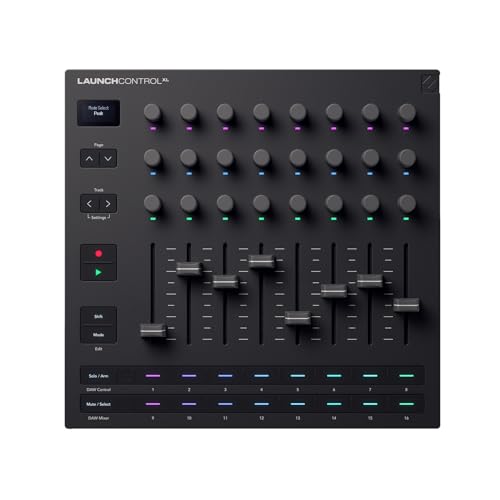
- 8 faders, 24 encoders, and 16 assignable buttons
- 5-pin MIDI I/O for hardware synths and effects
- USB-C bus power with up to 15 custom modes
Best For: Hybrid musicians who want DAW and hardware control in one compact surface
Universal DAW Remote – Behringer X-TOUCH Universal Control Surface
If you want a control surface with touch sensitive faders for hands-on DAW mixing, the Behringer X-TOUCH gives you nine 100 mm motorized faders, LCD scribble strips, and broad support for common control protocols. It is built for studio and live use, and its USB, Ethernet, and MIDI connectivity make it a flexible fit for compatible production setups.
Best For: Producers and engineers who want a versatile, 9-fader DAW remote with clear track labeling.
Pros:
- 9 fully automated, touch-sensitive 100 mm motorized faders
- 8 dynamic LCD scribble strips for track and parameter feedback
- Supports HUI and Mackie Control for broad DAW compatibility
- Ethernet, USB, and MIDI connectivity for flexible integration
Cons:
- No dedicated software bundle is listed in the supplied notes
- Larger footprint may be more than some compact desks need
The X-TOUCH is a practical pick if you need a more traditional mixer-like workflow with visible channel information and touch response under each fader. Its protocol support and multi-connection design make it a strong all-around control surface for compatible music production software.
Compact Multi-Fader Mixer – PreSonus FaderPort 16 DAW Controller
The PreSonus FaderPort 16 is a strong control surface with touch sensitive faders for users who want a compact but serious mixing workflow. It combines 16 motorized faders, 16 scribble strips, and deep transport, navigation, and automation controls, so you can manage more of a session without relying on the mouse.
Best For: Engineers and producers who want 16-fader control in a desk-friendly chassis.
Pros:
- 16 touch-sensitive, 100 mm motorized faders
- 16 high-definition scribble strips for quick channel identification
- Session Navigator adds scrolling, zoom, and master fader control
- Works with major DAWs on Mac and Windows via HUI/MCU emulation
Cons:
- Some advanced workflows may require learning the control modes
- Footswitch is not included, even though a jack is provided
If you want a lot of faders without moving to a full console, the FaderPort 16 is one of the most capable options here. It is especially appealing if you use Studio One, but the broader compatibility makes it a sensible choice for mixed DAW environments.
Single-Fader DAW Control – Behringer X-TOUCH ONE Universal Control Surface
The Behringer X-TOUCH ONE is a compact control surface with touch sensitive faders for users who want focused DAW control in a small footprint. It centers on one touch-sensitive motor fader, a scribble strip, and lighted buttons, with support for common DAW protocols and preset mappings for major music software.
Best For: Solo creators who want a portable one-fader controller for essential DAW tasks.
Pros:
- Touch-sensitive motor fader in a compact format
- LCD scribble strip helps identify the current channel
- Supports HUI and Mackie Control protocols
- Includes labelled DAW templates and user preset assignment options
Cons:
- Single-fader layout is less suited to larger mixing sessions
- Supplied notes do not list a software bundle
This is a straightforward choice when you want tactile control without dedicating much desk space. For transport, automation, and channel-level work, the X-TOUCH ONE keeps the workflow simple while still offering the responsiveness of a touch-sensitive motorized fader.
Protected 16-Channel Controller – PreSonus FaderPort 16 with Decksaver Cover
If you are shopping for a control surface with touch sensitive faders and want protection built in, this PreSonus FaderPort 16 bundle pairs the 16-channel controller with a Decksaver cover. The controller itself offers 16 touch-sensitive, 100 mm motorized faders, high-definition scribble strips, and broad session controls for music production, mixing, and recording on Mac and PC.
Best For: Users who want the FaderPort 16 plus a protective cover for studio storage.
Pros:
- 16 touch-sensitive, 100 mm motorized faders
- 16 high-definition scribble strips for fast channel identification
- Includes a polycarbonate Decksaver cover for dust and scratch protection
- Session controls cover undo/redo, arm all, solo/mute clear, and tap tempo click
Cons:
- The notes do not specify any included software bundle
- Bundle is better suited to users who specifically want the cover included
As a bundle, this package adds practical protection to an already capable DAW controller. It makes the most sense if you plan to leave the unit on a desk and want a ready-made way to keep it safe between sessions.
Compact Touch-Driven DAW Control – Behringer X-TOUCH COMPACT
If you want a control surface with touch sensitive faders for hands-on DAW work, the BEHRINGER X-TOUCH COMPACT is built around quick, familiar mixing control. It combines 9 fully automated, touch-sensitive 100 mm motorized faders with Mackie Control emulation, so it can slot into compatible software with less setup friction. The dual-layer mode also helps you switch between DAW and instrument control without rebuilding your workflow.
Best For: Producers who want a compact USB control surface with motorized, touch-sensitive faders and broad DAW compatibility.
Pros:
- 9 touch-sensitive 100 mm motorized faders for tactile mix moves
- Mackie Control emulation for seamless integration with compatible software
- Dual-layer mode for switching between DAW and instrument control
- Pre-configured controls for fast out-of-the-box use
Cons:
- Compact layout may feel tight if you want a larger mixer-style surface
- Designed around compatible music production software rather than universal hardware use
Overall, this is a practical pick if your priority is a compact, touch-sensitive fader surface that’s ready for DAW mixing and quick parameter control. It favors workflow speed and software integration over extra physical size or complexity.
Portable Wireless Fader Control – Korg nanoKONTROL Studio
The Korg nanoKONTROL Studio is a control surface with touch sensitive faders in a portable format that suits mobile and desktop production. It offers 8 faders plus backlit switches, and its Bluetooth and USB connectivity give you more flexibility when working with a laptop, tablet, or smartphone. The compact, lightweight design makes it easier to carry than a full-size controller.
Best For: Mobile producers and small-studio users who want a compact Bluetooth/USB control surface for quick mix control.
Pros:
- 8 faders with backlit switches for hands-on control
- Bluetooth and USB connectivity for added placement freedom
- Compact, lightweight build suited to travel or small setups
- Supports common production software including Ableton Live, Pro Tools, and FL Studio
Cons:
- Fewer faders than larger studio control surfaces
- Best suited to compact workflows rather than deep console-style mixing
This model is a strong fit if you need a small control surface that keeps tactile mixing close at hand without locking you to a cable. It balances portability with enough fader access for straightforward production tasks.
Pro-Grade Tactile Mixing Surface – Mackie MCU Pro
If you need a control surface with touch sensitive faders for more exact mix work, the Mackie MCU Pro is aimed at serious DAW control. It uses Mackie’s proprietary communication protocol, which is designed for seamless software integration and avoids manual mapping. With 100 mm touch-sensitive optical Alps motorized faders, plus V-Pots and dedicated buttons, it’s built for detailed hands-on production control.
Best For: Producers and engineers who want a professional USB control surface with motorized, touch-sensitive faders and deep software integration.
Pros:
- 100 mm touch-sensitive optical Alps motorized faders for precise mixing
- Proprietary Mackie protocol for easy setup with compatible software
- More than 50 dedicated push-buttons for fine parameter control
- V-Pots and transport controls support detailed DAW navigation
Cons:
- Larger and heavier than compact desktop controllers
- Built for DAW integration, so it’s less about general-purpose portability
This is the most feature-rich choice in the group for users who want a traditional control surface feel and reliable software integration. If you value tactile precision and a more console-like workflow, it stands out clearly.
Modular Creator Desk Control – Cooler Master MasterHUB for Editing & Streaming
If you want a control surface with touch sensitive faders that can also reshape around your workflow, the Cooler Master MasterHUB stands out for its modular layout. It combines 15 display keys, 5 fader modules, and 2 rollers into a single magnetic system, so you can build a desk controller for shortcuts, levels, and navigation without a fixed layout.
Best For: Streamers, editors, and PC users who want a customizable modular control surface with tactile faders and labeled keys.
Pros:
- 15 integrated display keys make commands easy to label and recognize at a glance.
- Magnetic modules let you rearrange buttons, faders, and dials quickly.
- Physical faders and rollers are useful for audio, timeline, and system adjustments.
- USB-C connection and Freeform 2.0 support keep setup straightforward.
Cons:
- Works as a modular macro pad rather than a dedicated DAW mixer.
- Designed for Windows and PC-focused workflows.
Overall, this is a flexible desk controller for users who want more than a basic macro pad. Its biggest strength is how easily it adapts to editing, streaming, and workflow control with physical fader input.
Professional DAW Mixer Surface – iCON V1-M Touch-Sensitive Motorized Faders
The iCON Pro Audio V1-M is a control surface with touch sensitive faders built for serious DAW work. It pairs 8 touch-sensitive motorized faders with a 7-inch touchscreen, OLED feedback, and meter bridge, giving you hands-on control of levels, transport, and DAW functions without relying on the mouse.
Best For: Music producers and studio users who want a dedicated motorized-fader DAW controller with deep software integration.
Pros:
- 8 touch-sensitive motorized faders with 12-bit resolution provide precise level control.
- Large 7-inch touchscreen and layered workflow support access to many DAW functions.
- Works with major DAWs including Cubase, Logic Pro, Ableton Live, and Pro Tools.
- Metal casing and Kensington lock port add a professional studio feel.
Cons:
- Bulkier than compact desktop controllers.
- Best suited to DAW production rather than general-purpose desktop control.
For engineers and producers who want tactile mixing control, the V1-M is clearly focused on workflow speed and DAW integration. Its motorized faders and screen feedback make it a strong fit for studio environments.
Hybrid MIDI Control Surface – Novation Launch Control XL 3 for DAWs & Hardware
The Novation Launch Control XL 3 is a compact control surface with touch sensitive faders in the sense that it’s designed for direct hands-on mixing and parameter control, while adding deep MIDI flexibility for DAWs and hardware. With 8 faders, 24 endless encoders, 16 assignable buttons, and MIDI I/O, it’s built for users who want one surface to manage software, synths, and hybrid setups.
Best For: Hybrid musicians and producers who need a USB-powered MIDI control surface for DAWs and external gear.
Pros:
- 8 faders, 24 endless encoders, and 16 customizable buttons cover a wide range of control needs.
- 5-pin MIDI In/Out/Out2-Thru supports hardware synths and effects without a computer.
- Deep DAW integration for Ableton Live, Logic Pro, FL Studio, Cubase, and HUI workflows.
- USB-C bus power and up to 15 Custom Modes make it flexible and portable.
Cons:
- No motorized faders are listed.
- It’s more of a MIDI/parameter controller than a full mixing console.
This model is best when you need a flexible bridge between software and hardware rather than a traditional studio mixer. Its strength is custom mapping and hybrid workflow support, especially in compact setups.
How We Picked the Best Control Surface with Touch Sensitive Faders
We focused on build quality, fader response, software compatibility, DAW integration, and the overall usefulness of each Control Surface with Touch Sensitive Faders for real-world mixing. We also weighed channel count, transport controls, scribble-strip clarity, and whether the unit fits a compact desk or a full production rig.
Quick Comparison
The right choice usually comes down to workflow. Some buyers need a simple single-fader unit for precise automation passes, while others want 8- or 16-channel control for faster banked mixing. If you already work inside one DAW, deeper integration may matter more than extra hardware controls. If you move between software or hardware, broader MIDI support is often the safer bet.
Key Buying Factors for a Control Surface with Touch Sensitive Faders
Fader Count and Layout
More faders can improve speed, but only if you actually need them. A single-fader model is ideal for hands-on ride automation and focused editing, while 8- and 16-fader layouts are better for tracking sessions and stem balancing.
Touch Sensitivity and Motorization
Touch-sensitive faders help the controller know when you are physically touching a channel, which improves automation writing and prevents unwanted moves. Motorized faders add another layer of convenience by snapping to stored session levels when you change banks or reopen a project.
DAW Compatibility
Check whether the unit offers native support for your DAW. Strong integration can mean better track naming, transport behavior, automation modes, and banking. Generic MIDI support is useful, but native control usually feels more seamless.
Extra Controls and Workflow Tools
Scribble strips, transport buttons, rotary encoders, and backlit keys can make a big difference during long sessions. If your desk space is limited, prioritize the controls you will use most often rather than chasing the largest feature list.
Who Should Buy Which Control Surface with Touch Sensitive Faders?
If you want the simplest path to hands-on mixing, choose a compact single-fader or small MIDI surface. If you edit and mix often, an 8-fader or 16-fader Control Surface with Touch Sensitive Faders is the better productivity upgrade. Studio owners working across multiple DAWs should favor broad compatibility and clear labeling, while users inside one ecosystem may benefit most from deeper software-specific integration. For hybrid setups that include hardware synths or external gear, pick a controller with strong MIDI routing and enough assignable controls to handle both worlds.