Looking for a compact way to play melodies, program drums, and sketch beats fast? A MIDI controller keyboard with drum pads can be the most versatile centerpiece in a small studio.
In this roundup, we focus on the best options for portability, pad response, workflow, and creative features so you can choose the right controller for your setup and budget.
Best 10 MIDI Controller Keyboard with Drum Pads Picks for 2026
Compact Beat-Making Starter
Akai MPK Mini MK3 25-Key Controller

- 25 velocity-sensitive mini keys
- 8 MPC-style pads with Note Repeat and Full Level
- 8 knobs plus arpeggiator and thumbstick control
Best For: Beat makers and home-studio producers needing a portable controller
Hands-On Workflow Choice
Arturia MiniLab 3 25-Key Controller

- 8 RGB drum pads in 2 banks
- 4 faders plus 8 rotary encoders
- Includes Ableton Live Lite and Analog Lab Intro
Best For: Producers who want a compact controller with a flexible workflow
Feature-Packed Studio Pick
TempoKey K25 MIDI Controller with OLED
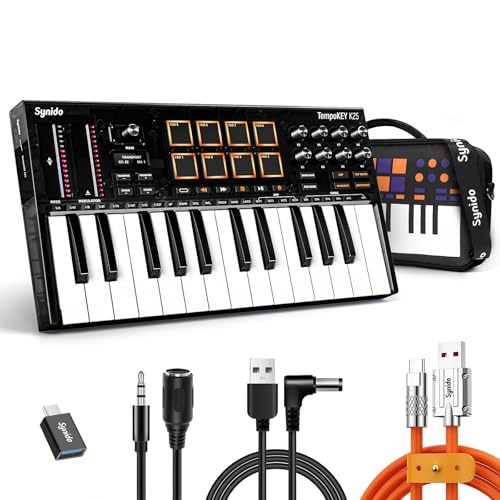
- 8 RGB pads with dual drum banks
- OLED screen and push encoder for direct editing
- USB-C plus MIDI out and sustain input
Best For: Producers who want deeper onboard control and editing
Wireless Portable Performer
Bluetooth MIDI Keyboard with 16 Pads

- Bluetooth and USB connectivity
- Built-in rechargeable battery for up to 16 hours
- 8 RGB drum pads and 8 assignable knobs
Best For: Mobile creators who want wireless beat-making flexibility
Compact Starter Pick
Donner N-25 25-Key Mini Controller

- 25 velocity-sensitive mini keys
- Beginner-friendly controls and 40 courses
- USB-MIDI support for Mac, PC, iOS, Android
Best For: Beginners who want a small, simple controller for learning and portable use
Beat-Making Hybrid
Akai MPK Mini Play MK3 with Pads and Sounds

- 8 velocity-sensitive MPC drum pads
- Built-in speaker and 100+ internal sounds
- 25 keys, knobs, arpeggiator, and note repeat
Best For: Beat makers who want drum pads plus standalone sounds in a portable controller
Pad-Focused Pro Mini
Donner DMK 25 Pro USB-C Controller with Pads

- 8 drum pads and 25 velocity-sensitive keys
- Smart scale mode, chord tools, and arpeggio
- USB-C support for PC and mobile workflows
Best For: Producers who want pad control and compact DAW-friendly features
Portable MPC Pad Controller
Akai MPK Mini IV 25-Key USB-C Controller

- 8 RGB MPC pads with pressure sensitivity
- 25 mini velocity-sensitive keys
- USB-C, MIDI Out, and DAW mapping
Best For: Beat makers and portable studio setups
Expanded Sequencer Pick
Akai MPK Mini Plus 37-Key Beat Controller

- 37 keys with 3 full octaves
- 64-step sequencer for drums and melodies
- CV/Gate and MIDI I/O for external gear
Best For: Producers using both DAWs and hardware synths
Best Value Starter
Akai MPK Mini MK3 25-Key Drum Pad Controller

- 8 backlit MPC-style pads
- 25 velocity-sensitive mini keys
- 8 knobs plus built-in arpeggiator
Best For: Beginners building a compact beat-making setup
Compact Beat-Making Starter – Akai MPK Mini MK3 25-Key Controller
If you want a MIDI controller keyboard with drum pads that stays small but still gives you real hands-on control, the Akai MPK Mini MK3 is built for exactly that job. It combines 25 velocity-sensitive mini keys, 8 MPC-style pads, and 8 knobs with an arpeggiator and pitch/mod thumbstick, making it a practical fit for beat building, sketching melodies, and controlling your DAW from a compact desk setup.
Best For: Beat makers, home-studio producers, and beginners who want a portable all-in-one controller.
Pros:
- 8 backlit velocity-sensitive MPC-style pads with Note Repeat and Full Level for drum programming and sample triggering.
- 8 assignable knobs for mixing, synth tweaks, and plugin control.
- Built-in arpeggiator plus 4-way thumbstick for pitch and modulation control.
- Includes a software bundle with MPC Beats, virtual instruments, and sound content.
Cons:
- Mini keys may feel cramped if you prefer a larger playing surface.
- Only 25 keys, so it is better for sketches than full piano-style parts.
This is a strong pick if portability and pad-based beat making matter more than a full-sized keyboard. It gives you the core controls most producers need in a lightweight format without adding much desk clutter.
Hands-On Workflow Choice – Arturia MiniLab 3 25-Key Controller
The Arturia MiniLab 3 is a MIDI controller keyboard with drum pads that leans into an organized, tactile workflow. With 25 slim keys, 8 RGB pads, 8 rotary encoders, and 4 faders, it is designed for users who want to mute tracks, trigger drums, shape parameters, and browse sounds without relying on the mouse as much.
Best For: Producers who want a compact controller with a flexible, hands-on layout.
Pros:
- 2 banks of 8 velocity- and pressure-sensitive RGB pads for drum triggering and performance.
- 8 rotary encoders and 4 faders for direct control over instruments and mix settings.
- Built-in arpeggiator plus clickable browsing knob and mini display for faster navigation.
- Includes a software suite with Ableton Live Lite, Analog Lab Intro, and UVI Model D.
Cons:
- Uses slim keys, which may not suit players who want a larger key feel.
- The included software bundle is introductory rather than a full professional package.
MiniLab 3 is a good option if you value a clear control layout and want pads, faders, and knobs in one compact unit. It is especially appealing for producers who like a streamlined workflow and software integration out of the box.
Feature-Packed Studio Pick – TempoKey K25 MIDI Controller with OLED
If you want a MIDI controller keyboard with drum pads and a more advanced control set, the TempoKey K25 adds several studio-friendly features in a compact body. Along with 25 velocity-sensitive keys and 8 RGB backlit pads, it includes an OLED screen, a push encoder, assignable knobs, transport buttons, and a built-in arpeggiator for quicker editing and performance control.
Best For: Producers who want more onboard editing and control than a basic mini keyboard offers.
Pros:
- 8 velocity-sensitive RGB pads with dual drum banks, note repeat, and full MIDI mapping.
- OLED display and 360° push encoder for editing notes, CC, program changes, and MIDI channels.
- Built-in arpeggiator with tempo, direction, swing, and latch adjustment.
- USB-C plus 1/8" MIDI out and sustain pedal input for flexible setup options.
Cons:
- More feature-heavy than a basic starter controller, so it may feel overbuilt for simple use.
- The product notes indicate it is a MIDI controller only, so it does not generate sound on its own.
The K25 stands out if you want a compact controller that still gives you deeper on-device editing and more performance tools. It is a practical choice for beat makers who want to spend less time in menus and more time shaping ideas.
Wireless Portable Performer – Bluetooth MIDI Keyboard with 16 Pads
This MIDI controller keyboard with drum pads is aimed at players who want wireless convenience as much as hands-on beat making. It pairs 25 velocity-sensitive keys with 8 RGB drum pads, 8 assignable knobs, and Bluetooth connectivity, so you can work across supported devices without being tied to a cable all the time.
Best For: Mobile creators who want a compact wireless controller for studio or travel use.
Pros:
- Bluetooth and USB connectivity for flexible wired or wireless use.
- Built-in 2000mAh rechargeable battery with up to 16 hours of playtime.
- 8 RGB backlit velocity-sensitive drum pads plus 8 assignable rotary encoders.
- Compatible with Windows, Mac OS, Android, and iOS devices.
Cons:
- Wireless features may not matter if you only plan to use it at a fixed desk setup.
- The notes emphasize broad compatibility, but the included software detail is limited.
Choose this model if portability and cable-free setup are high on your list. It offers the essential pad-and-key workflow in a travel-friendly format that can move easily between studio, café, and hotel use.
Compact Starter Pick – Donner N-25 25-Key Mini Controller
If you want a MIDI controller keyboard with drum pads in a very compact form, the Donner N-25 keeps things simple and beginner-friendly. It focuses on velocity-sensitive mini keys, basic control functions, and bundled teaching content rather than a heavy feature set.
Best For: Beginners, students, and portable setups where small size and easy USB-MIDI use matter most.
Pros:
- 25 velocity-sensitive mini keys in a lightweight, portable body
- Beginner-friendly tools including arpeggiator, sustain, octave, and tap tempo
- Compatible with Mac, Windows, iOS, and Android devices via USB-MIDI or OTG
- Includes 40 teaching courses plus software for getting started
Cons:
- Does not include drum pads, so it is not ideal if pad drumming is a priority
- No built-in sound engine or standalone playback
- Small mini keys may feel cramped for some players
Overall, the N-25 is a practical entry-level choice for simple music production and learning. It is best viewed as a compact keyboard controller first, with convenience and affordability taking priority over pad-based beat making.
Beat-Making Hybrid – Akai MPK Mini Play MK3 with Pads and Sounds
The Akai MPK Mini Play MK3 is a strong option if you want a MIDI controller keyboard with drum pads and built-in sound generation in one portable unit. It combines 8 velocity-sensitive MPC pads, 25 mini keys, and onboard sounds, making it useful for sketching beats and melodies without always relying on a computer.
Best For: Beat makers, traveling musicians, and anyone who wants pads, keys, and built-in sounds in a compact controller.
Pros:
- 8 velocity-sensitive backlit MPC drum pads for beat programming
- Built-in speaker and over 100 internal sounds for standalone use
- 25-key mini keybed plus arpeggiator and note repeat
- Includes software, educational lessons, and NKS integration support
Cons:
- Mini keys may not suit players who prefer full-size keys
- Batteries are not included for portable operation
- Built-in speaker is convenient, but not a substitute for studio monitors
This is the most flexible pick here if you want a pad-focused compact controller that can also play on its own. It suits fast beat ideas, mobile sessions, and beginners who want extra creative tools in a single device.
Pad-Focused Pro Mini – Donner DMK 25 Pro USB-C Controller with Pads
The Donner DMK 25 Pro is a compact MIDI controller keyboard with drum pads built for hands-on beat creation and mobile or desktop production. It adds 8 drum pads, smart scale modes, arpeggio, chord tools, and transport-style controls, giving you more performance options than a basic mini keyboard.
Best For: Producers who want pad control, smart scale features, and a compact USB-C controller for software-based music making.
Pros:
- 8 drum pads plus 25 velocity-sensitive keys for beat and melody work
- Smart Dynamic Scale Mode and 16 scale tones for quick idea building
- Arpeggio, note repeat, chord functions, and transport controls for workflow speed
- USB-C connectivity with support for PC and mobile devices
Cons:
- Does not produce sound on its own and must be used with DAW software
- Mobile compatibility depends on having the correct OTG adapter
- Mini-key format may be less comfortable for pianistic playing
If you want more pad-driven control than a basic starter board, the DMK 25 Pro is a well-equipped compact choice. Its added scale tools and transport features make it especially useful for faster songwriting and beat sequencing.
Portable MPC Pad Controller – Akai MPK Mini IV 25-Key USB-C Controller
If you want a MIDI controller keyboard with drum pads that stays compact without feeling stripped down, the Akai Professional MPK Mini IV is built for beat making and quick sketching. It combines 25 velocity-sensitive mini keys, 8 MPC pads, and hands-on control tools like knobs, a screen, and transport mapping for a streamlined production setup.
Best For: Beat makers, traveling producers, and beginners who want a compact controller with modern DAW integration.
Pros:
- 8 velocity- and pressure-sensitive MPC pads with RGB feedback for finger drumming.
- 25 mini velocity-sensitive keys plus chord and scale modes for fast idea building.
- 8 assignable 360° knobs and a full-color screen for hands-on control.
- USB-C connectivity, MIDI Out, and plug-and-play support for Mac, PC, and mobile setups.
Cons:
- Mini keys may not suit players who prefer a full-size keybed.
- Pad count is limited to 8 if you want a larger drum grid.
Overall, this is a strong pick if you want a portable controller that balances performance features with a simple workflow. The included software and pre-mapped DAW support make it especially appealing for fast setup and everyday production.
Expanded Sequencer Pick – Akai MPK Mini Plus 37-Key Beat Controller
For buyers comparing a MIDI controller keyboard with drum pads and wanting more room to play, the Akai Professional MPK Mini Plus steps up with 37 keys and deeper hardware control. It adds 8 RGB MPC pads, a 64-step sequencer, and CV/Gate plus MIDI I/O, making it a flexible option for both DAW-based work and hardware setups.
Best For: Producers who want more keys, onboard sequencing, and connectivity for modular or external gear.
Pros:
- 37-key layout gives you 3 full octaves for melodic and harmonic performance.
- Built-in 64-step sequencer can handle drums, melodies, or chords without a computer.
- 8 premium RGB MPC pads support dynamic beat programming and sample triggering.
- CV/Gate and MIDI I/O expand control beyond a typical USB-only controller.
Cons:
- Larger size is less travel-friendly than the 25-key MPK Mini models.
- More features may be unnecessary if you only need a simple pad controller.
This model makes sense if you want a compact controller but need extra octaves and standalone sequencing. It is the most versatile choice here for hybrid setups that combine software instruments and external hardware.
Best Value Starter – Akai MPK Mini MK3 25-Key Drum Pad Controller
The Akai Professional MPK Mini MK3 remains a practical entry point if you want a MIDI controller keyboard with drum pads for beat making and home studio work. It pairs 25 velocity-sensitive mini keys with 8 backlit MPC-style pads, 8 knobs, and an arpeggiator, giving you the essentials for programming drums, triggering samples, and shaping sounds.
Best For: Beginners and home producers who want a compact controller with the core MPC workflow.
Pros:
- 8 backlit velocity-sensitive MPC-style pads with Note Repeat and Full Level.
- 25 mini velocity-sensitive keys keep the footprint small for desktop setups.
- 8 assignable 360-degree knobs for plugin and mix control.
- Built-in arpeggiator and included software bundle add quick creative tools.
Cons:
- Uses a USB 2.0 Type-B connection instead of newer USB-C.
- Mini keys may feel cramped for players used to larger keyboards.
If you want a straightforward controller that covers the basics well, this model still holds up. It offers a strong mix of pads, keys, and software without adding extra complexity or a bigger footprint.
How We Picked the Best MIDI Controller Keyboard with Drum Pads
We focused on controllers that balance playable keys, responsive drum pads, and practical music-production features. Priority went to models with strong software support, reliable build quality, good portability, and enough hands-on controls to speed up beatmaking and performance.
Quick Comparison
Some buyers want the simplest plug-and-play option for sketching ideas, while others need deeper control for finger drumming, sequencing, or chord work. Smaller 25-key models are best for portability and beat programming, while larger layouts and advanced functions suit players who want more range and a more complete writing workflow.
Key Buying Factors for a MIDI Controller Keyboard with Drum Pads
Pad Feel and Sensitivity
For beatmaking, pads should respond consistently to light taps and harder hits. Look for velocity-sensitive pads if you want more expressive drum programming and better dynamics.
Key Size and Key Count
Mini keys are ideal for travel and desk setups, but they are less comfortable for piano-style playing. If you plan to write basslines, chords, and two-handed parts more often, consider whether 37 keys better fits your workflow than a 25-key layout.
Controls and Workflow
Knobs, arpeggiators, chord modes, scale modes, and transport controls can make a big difference. A MIDI Controller Keyboard with Drum Pads becomes far more useful when it lets you stay in creative flow without constantly reaching for the mouse.
Connectivity and Compatibility
Check whether you need USB, USB-C, or wireless connectivity, and make sure the controller works smoothly with your DAW and devices. For laptop-based production, simple bus-powered USB operation is usually the easiest path.
Software and Value
Bundled instruments, DAW integration, and beginner-friendly software can add real value, especially if you are just starting out. Experienced users may care more about hardware controls and workflow than software extras.
Who Should Buy Which MIDI Controller Keyboard with Drum Pads?
Beginners should look for an easy, compact controller with clear controls and included software. Beatmakers and finger drummers will usually benefit most from responsive pads, dedicated knobs, and features that support faster pattern creation. Traveling producers should prioritize size, weight, and power simplicity, while players who want a fuller composing experience should consider a larger key count and more performance tools.
If your main goal is writing beats, sketching hooks, and controlling virtual instruments in one device, a well-chosen MIDI Controller Keyboard with Drum Pads offers one of the best value-to-versatility ratios in home music production.