Managing speakers in several rooms is easier with the right selector switch. The best speaker selector switches with volume control let you route audio to separate zones, adjust listening levels independently, and keep a multi-room setup organized.
This roundup compares 10 options ranging from compact two-way switches to higher-capacity six-zone controllers, with attention to zone count, source flexibility, impedance protection, construction, and everyday usability.
Best 10 Speaker Selector Switches with Volume Control Picks for 2026
Best Multi-Zone Pick

- Controls up to six speaker pairs
- Independent volume for each pair
- 100W per channel with overload protection
Best For: Larger whole-home audio systems
Best Simple Setup

- Connects up to four speaker pairs
- Push-button plug-and-play operation
- Handles 100W per channel at 8 ohms
Best For: Straightforward stereo speaker distribution
Best Dual-Input Option

- Supports six independently switchable zones
- Accepts two amplifiers or receivers
- 300W RMS per channel with impedance protection
Best For: Whole-house systems with dual audio sources
Best 4-Zone Volume Control
Pyle PLSHVC412 Speaker Selector

- Controls up to four speaker pairs
- Individual volume settings for each pair
- Aluminum housing with cabinet heat sink
Best For: Smaller multi-room home theater systems
Whole-Home Control
Six-Zone Stereo Speaker Selector

- Six speaker-pair outputs with independent controls
- Switches between two stereo sources
- Selectable impedance matching and passive operation
Best For: Whole-home audio systems with up to six rooms
Reliable Four-Zone Value
Monoprice SSVC-4.1 Four-Zone Selector
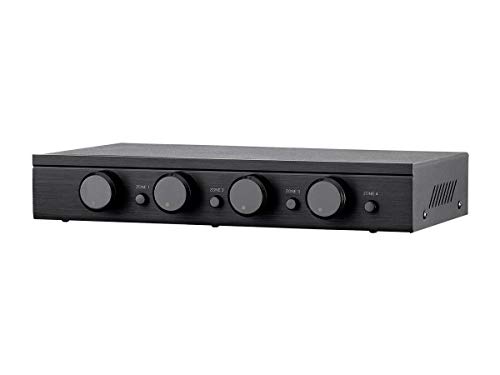
- Four independently controlled speaker zones
- Automatic impedance protection circuitry
- Handles up to 100 watts per channel continuously
Best For: Four-zone systems using one amplifier
Compact Two-Way Option
XtremPro 61052 Two-Way Selector

- Drives two speaker pairs from one receiver
- Individual control for each speaker pair
- No external power supply required
Best For: Small two-pair residential or commercial audio setups
Six-Zone Control
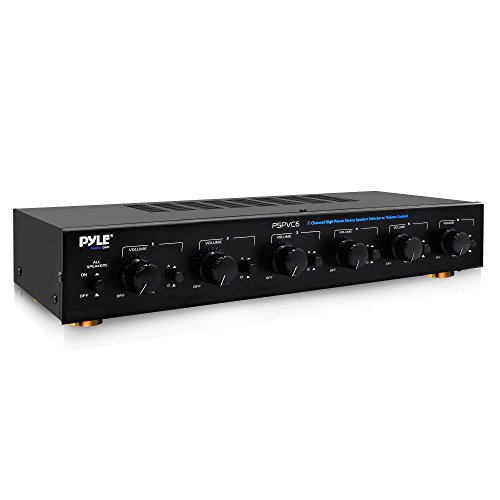
- Controls up to six speaker connections
- Includes volume control
- Stereo, corded distribution box
Best For: Larger multi-zone speaker setups
Compact Four-Zone Choice
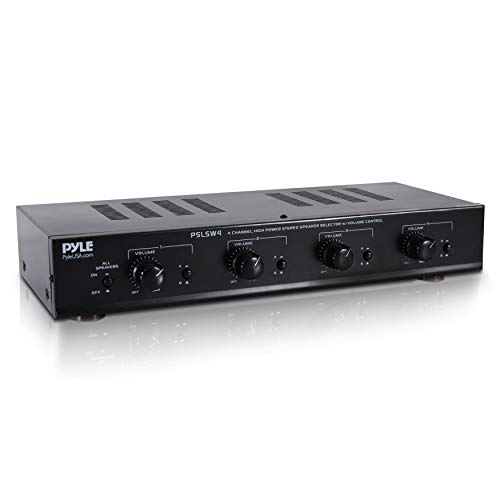
- Supports four pairs of 8-ohm speakers
- Independent volume controls
- 100W per channel with overload protection
Best For: Compact home theater and stereo systems
Flexible A/B Distribution
Pyle PSLSW4 Four-Zone Selector
- Controls four speaker pairs or eight speakers
- Independent volume and push-button selection
- 100W maximum per channel
Best For: Stereo systems needing selectable speaker zones
Best Multi-Zone Pick – 6-Channel Speaker Selector
The Pyle PSLSW6 is a practical choice if you need speaker selector switches with volume control for a larger home theater or stereo setup. It supports up to six speaker pairs, with independent volume knobs and push-button activation for each pair.
Best For: Whole-home audio setups needing control over up to six 8-ohm speaker pairs.
Pros:
- Controls up to six speaker pairs individually or in combination.
- Independent audio-source volume controls simplify zone-by-zone adjustments.
- Supports up to 100 watts per channel and includes overload protection.
- Accepts speaker wire up to 14 AWG through screw terminals.
Cons:
- Designed for 8-ohm speakers.
- The tabletop enclosure is relatively wide at 16.9 inches.
With six zones, front-panel controls, and overload safety circuitry, this is the most capable option here for managing multiple speaker pairs from one stereo receiver.
Best Simple Setup – 4-Channel A/B/C/D Selector
The Pyle PSS4 keeps speaker distribution straightforward for buyers seeking speaker selector switches with volume control in a compact, push-button design. It connects up to four separate speaker pairs and accepts speaker wire up to 14 gauge.
Best For: Basic stereo systems that need four selectable speaker pairs without a complex control box.
Pros:
- Supports up to four separate speaker pairs.
- Push-button operation provides simple plug-and-play control.
- Handles up to 100 watts per channel with 8-ohm speaker systems.
- Compact 7.48-by-4.72-inch footprint fits easily near a receiver.
Cons:
- The supplied notes do not specify independent volume controls.
- It is intended for speakers with a minimum impedance of 8 ohms.
This model is a sensible budget-oriented distribution switch when straightforward A/B/C/D speaker selection matters more than individual zone volume adjustment.
Best Dual-Input Option – 6-Zone Volume Selector
Theater Solutions TS6DV Dual Input 6 Zone Speaker Selector Box Volume Controls
Check Price On AmazonThe Theater Solutions TS6DV is a strong fit for speaker selector switches with volume control when you want six zones and two receiver inputs. Its passive design lets you toggle zones individually or together, while each zone has its own volume control.
Best For: Whole-house audio installations using two amplifiers or receivers and multiple 8-ohm speaker pairs.
Pros:
- Provides six independently switchable zones with individual volume controls.
- Accepts two amplifiers or receivers through its A/B input selection.
- Handles up to 300 watts RMS per channel.
- Includes impedance protection and removable screw-bolt connectors for 14- to 22-gauge wire.
Cons:
- The passive design splits incoming signal and power among engaged zones.
- Installation requires raw speaker-wire outputs and CL3-rated in-wall speaker wire for connections.
Its dual-input flexibility and higher stated power handling make the TS6DV particularly useful for structured whole-house or commercial-style audio installations.
Best 4-Zone Volume Control – Pyle PLSHVC412 Speaker Selector
The Pyle PLSHVC412 combines four speaker outputs with individual volume settings, making it a useful choice among speaker selector switches with volume control for a smaller home cinema. Its aluminum housing, cabinet heat sink, and plug-and-play setup support a durable, easy-to-install design.
Best For: Home theater systems needing individual control for up to four 8-ohm speaker pairs.
Pros:
- Operates up to four speaker pairs individually or in tandem.
- Provides separate volume settings for each speaker pair.
- Accepts speaker wire up to 14 gauge.
- Aluminum construction and cabinet heat sink support a rugged enclosure.
Cons:
- Limited to four speaker pairs.
- Its stated maximum amplifier input is 100W RMS.
For a four-zone system, this Pyle offers the key controls most buyers need, including per-pair volume adjustment and push-button selection, without the larger six-zone layout.
Whole-Home Control – Six-Zone Stereo Speaker Selector
The OSD SSVC6D is a strong choice when you need speaker selector switches with volume control for a multi-room system. It supports up to six speaker pairs, lets each zone play at its own level, and switches between two stereo sources.
Best For: Whole-home audio setups with up to six independently controlled rooms.
Pros:
- Controls six speaker pairs with individual on/off buttons and 12-step volume knobs.
- Switches between two stereo receivers or amplifiers.
- Impedance matching offers 1X, 2X, 4X, and 8X settings for multi-room use.
- Passive design requires no outlet and supports speaker wire up to 14 AWG.
Cons:
- Its six-zone feature set may be more than needed for a small installation.
- Rated for up to 300W, so amplifier compatibility still needs checking.
With six zones, dual-source switching, and selectable impedance protection, the SSVC6D is the most capable option here for centralized whole-home speaker management.
Reliable Four-Zone Value – Monoprice SSVC-4.1 Four-Zone Selector
The Monoprice SSVC-4.1 is a practical pick among speaker selector switches with volume control for connecting multiple speaker pairs to one amplifier. It provides four independently controlled zones, automatic impedance protection, and sturdy screw-type connections.
Best For: Users who need four-zone speaker management from a single amplifier.
Pros:
- Offers individual zone on/off buttons and volume controls.
- Automatic impedance protection helps manage multiple selected speaker pairs.
- Supports 100 watts per channel continuously and 200 watts per channel peak.
- Heavy-duty connectors accept 12–18 AWG speaker wire.
Cons:
- Accepts one amplifier input rather than two selectable sources.
- Its four-zone capacity is lower than the six-zone OSD model.
The SSVC-4.1 balances useful zone controls, impedance protection, and solid wiring support, making it a sensible four-room alternative when dual-source switching is not required.
Compact Two-Way Option – XtremPro 61052 Two-Way Selector
The XtremPro 61052 is a simple, compact option for shoppers comparing speaker selector switches with volume control. It lets one conventional amplifier or stereo receiver drive two speaker pairs, with individual control for each pair and no separate power supply.
Best For: Basic residential or commercial setups needing two speaker outputs.
Pros:
- Controls two stereo speaker pairs from one amplifier or receiver.
- Provides individual control for each speaker pair.
- Requires no external power supply or impedance-matching device.
- Metal non-slip enclosure is designed for straightforward tabletop placement.
Cons:
- Limited to two speaker pairs and 60W per channel.
- Does not offer the multi-zone capacity or dual-source switching of larger selectors.
For a small two-pair installation, the 61052 keeps the setup straightforward and inexpensive; verify the amplifier and speaker requirements before connecting both outputs.
Six-Zone Control – Pyle PSPVC6 Speaker Selector
If you need speaker selector switches with volume control for a larger multi-room setup, the Pyle PSPVC6 provides six speaker connections in one distribution box. Its stereo design and corded operation suit systems built around a high-powered amplifier.
Best For: Multi-zone installations that need control of up to six pairs of speakers from a central box.
Pros:
- Supports six speaker connections for broader distribution.
- Includes volume control for managing connected zones.
- Compact black enclosure measures about 16.92 inches wide.
Cons:
- The supplied notes do not specify per-channel power handling.
- Its larger six-zone format may be more than smaller systems require.
The PSPVC6 is the most suitable choice here when connection capacity is the priority. Confirm your amplifier and speaker requirements before installation, especially because detailed impedance and power specifications are not provided in the notes.
Compact Four-Zone Choice – Pyle PSLSW4.5
The Pyle PSLSW4.5 is a practical option among speaker selector switches with volume control, supporting up to four pairs of 8-ohm speakers at a maximum of 100 watts per channel. Independent controls make it easier to adjust sound for separate zones.
Best For: Home theater and stereo systems needing four independently adjustable speaker zones in a compact tabletop design.
Pros:
- Supports up to four pairs of 8-ohm speakers.
- Provides independent volume control for each channel.
- Screw-type connectors accept speaker wire up to 14 AWG.
- Includes front-panel overload protection.
Cons:
- Its 100-watt-per-channel rating may not suit higher-powered systems.
- Four-zone capacity is less than a six-zone selector.
With clear zone-control features, overload protection, and a compact footprint, the PSLSW4.5 is a balanced pick for typical home audio installations. Match the selector with compatible 8-ohm speakers and stay within its stated power rating.
Flexible A/B Distribution – Pyle PSLSW4 Four-Zone Selector
For shoppers comparing speaker selector switches with volume control, the Pyle PSLSW4 combines four-zone speaker distribution with independent audio controls. It connects to a stereo amplifier or receiver through screw terminals and supports up to four speaker pairs.
Best For: Stereo amplifier and home theater setups that need selectable speaker pairs and separate volume adjustment.
Pros:
- Controls up to four speaker pairs, or eight speakers.
- Offers independent volume controls and push-button pair selection.
- Accepts speaker wire up to 14 AWG through screw terminals.
- Provides overload protection and a master speaker switch.
Cons:
- Specified for 100 watts maximum per channel and 8-ohm speakers.
- The unit is about 16.9 inches wide, so it needs suitable tabletop space.
The PSLSW4 is a well-rounded four-pair controller for users who want both zone selection and independent volume adjustment. Its A/B inputs and straightforward screw-terminal setup make it practical for compatible stereo systems.
How We Picked the Best Speaker Selector Switches with Volume Control
We focused on practical features that matter when distributing stereo audio across multiple rooms or speaker pairs. The products in this roundup were compared by the number of supported zones, individual volume controls, source-input flexibility, speaker-selection controls, impedance protection, build quality, and installation convenience. We also considered whether each unit suits a compact home system, a larger multi-room arrangement, or a basic A/B speaker-switching setup.
Because product specifications and included connections can vary, verify the manufacturer’s wiring guidance and power-handling limits before connecting high-powered amplifiers or low-impedance speakers.
Quick Comparison
- Two-way switching: Best for one amplifier feeding two speaker pairs or zones.
- Four-zone models: A practical middle ground for homes with several rooms or listening areas.
- Six-zone models: Better for larger installations and more extensive multi-room coverage.
- Dual-input models: Useful when you need to choose between two audio sources as well as distribute sound.
- Individual volume controls: Essential when each room needs its own listening level.
Key Buying Factors for Speaker Selector Switches with Volume Control
Zone and Channel Count
Choose a unit with enough outputs for your current setup, plus some room for expansion. A four-zone selector is often sufficient for a typical home, while six-zone equipment makes more sense for larger properties or commercial spaces.
Source Compatibility
Check whether the selector accepts one source or multiple inputs. Single-input models are straightforward, but dual-input designs add flexibility if you switch between receivers, amplifiers, or other stereo sources.
Impedance Protection and Power Handling
When multiple speaker pairs share one amplifier, impedance can become a concern. Look for impedance-matching or protection circuitry where available, and compare the selector’s rated power handling with your amplifier and speakers. Do not assume that a volume knob alone protects connected equipment.
Controls and Installation
Front-panel zone buttons and independent volume knobs make daily operation easier. Also consider the enclosure size, terminal or connector type, ventilation, and whether the unit will sit on a shelf or be installed in a cabinet. Clearly labeling each zone can prevent wiring mistakes.
Who Should Buy Which Speaker Selector Switches with Volume Control?
Choose a two-way model if you need a simple, space-saving solution for switching between two speaker pairs. It is a good fit for a small room, office, or basic home stereo.
Choose a four-zone selector for a balanced combination of capacity and simplicity. This category suits most homes that want audio in a few rooms without the extra size of a larger distribution system.
Choose a six-zone selector when you are planning coverage across many rooms or want additional expansion capacity. These models are better suited to larger homes, entertainment spaces, and light commercial installations.
Choose a dual-input, multi-zone model if different areas may use separate audio sources. Before buying, confirm the number of inputs, zone volume range, connector layout, and compatibility with your amplifier so the selector matches the rest of your system.