Finding the right synthesizer workstation for live performance means balancing sound quality, hands-on control, and dependable stage workflow. The best options make it easy to switch sounds, layer parts, and stay focused on the show.
Below, we’ve focused on versatile instruments that suit keyboardists, producers, and performers who need practical tools for live sets, rehearsals, and touring.
Best 10 Synthesizer Workstation for Live Performance Picks for 2026
Flagship 88-Key Performance Workstation
Korg NAUTILUS AT 88 with Aftertouch
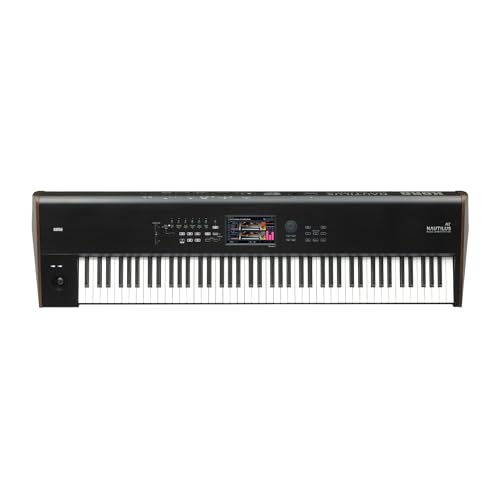
- 88-key RH3 weighted keyboard with aftertouch
- Set List mode for fast live sound changes
- 8-inch touch display and customizable quick access
Best For: Players who want expressive 88-key control and stage-friendly patch recall
Legendary Stage Synth
Roland JUPITER-X 61-key performance synth

- ZEN-Core engine recreates classic Roland sounds
- Aftertouch-enabled 61-key keyboard with hands-on control
- All-metal build designed for studio and stage
Best For: Performers who want premium classic-sound versatility in a rugged stage board
Compact Live-Action Mini Synth
Novation MiniNova compact 37-key synth

- 37 mini keys in a portable, compact design
- Animate buttons and arpeggiator for live control
- VocalTune and mic input add vocal processing
Best For: Gigging musicians who want a lightweight performance synth with vocal effects
Desktop Powerhouse for Control
Waldorf Iridium Core desktop synth

- Advanced arpeggiator and 64-step sequencer
- Assignable pads, macro buttons, and favorites screen
- Compact desktop unit with MIDI, USB, and CV connections
Best For: Players who want deep performance control in a desktop synth module
Flagship Standalone Beat Hub

- Standalone MPC workflow with no computer required
- 10.1-inch touchscreen and 16 RGB pads
- 8 CV/Gate outs plus MIDI and USB audio interface
Best For: Performers who want a powerful standalone workstation
Analog/Digital Crossover Pick
Roland JD-XI 37-Key Crossover Synth
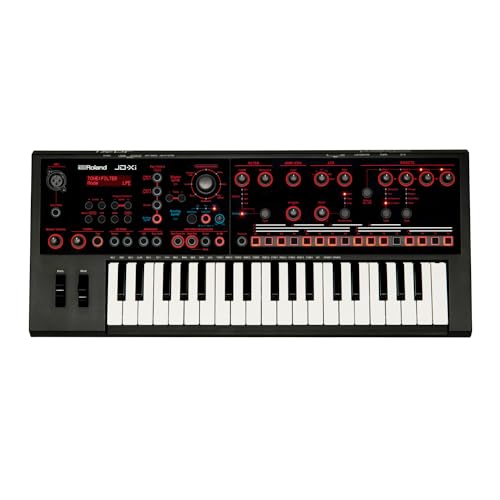
- Analog lead and bass tones plus digital SuperNATURAL sections
- Four-track pattern sequencer and rhythm sounds
- Includes mic for vocoder and AutoPitch effects
Best For: Keyboardists wanting a compact crossover synth for live use
Stage-Ready Sound Library
Roland JUNO-D6 61-Note Stage Keyboard

- Over 3800 onboard sounds with ZEN-Core engine
- 61-note synth-action keys for live playing
- USB-C audio/MIDI plus battery power support
Best For: Live band players needing fast access to essential stage sounds
Classic Polyphonic Analog
Behringer PRO-800 Classic Analog 8-Voice

- 8-voice pure analog polyphony
- Arpeggiator, sequencer, and 400 memories
- Prophet 600-style sound in Eurorack format
Best For: live players who want classic analog tones with practical recall
All-in-One Stage Workstation
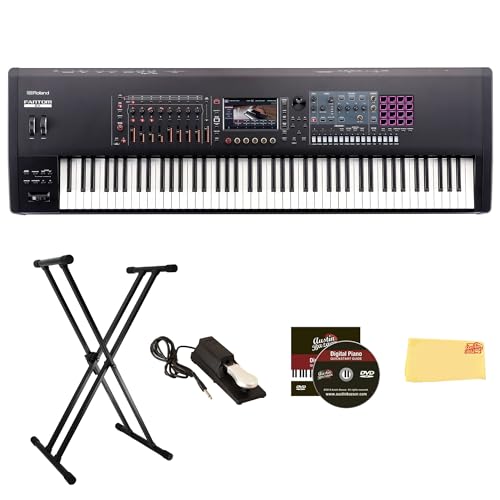
- Multiple engines: ACB, ZEN-Core, V-Piano, SuperNATURAL
- Over 7000 onboard tones with scene layering
- Sampling, RGB pads, and TR-REC sequencing
Best For: live keyboardists needing a flagship workstation with deep control
Portable Vector Performer
Behringer PRO-VS MINI Hybrid Vector Synthesizer

- Prophet VS-style vector synthesis engine
- Joystick morphing with 128 waveforms
- Sequencer, arpeggiator, and USB-C power
Best For: mobile performers who need compact, expressive synth control
Flagship 88-Key Performance Workstation – Korg NAUTILUS AT 88 with Aftertouch
If you want a synthesizer workstation for live performance with full-size weighted keys and deep set-list control, the Korg NAUTILUS AT 88 is built for that role. Its aftertouch, DYNAMICS knob, and 8-inch touch display make it easy to shape sounds on the fly, while Set List mode helps you recall the right patch quickly on stage.
Best For: Keyboard players who need an expressive 88-key workstation with fast live-sound recall.
Pros:
- 88-key RH3 weighted keyboard with aftertouch for expressive playing
- Set List mode with color-coded touchscreen buttons for live recall
- 8-inch touch-and-drag display plus customizable quick access controls
- DYNAMICS knob adds real-time control over volume and tone response
Cons:
- Large 88-key format is less portable than compact synths
- Advanced feature set may feel more complex than simpler stage keyboards
The NAUTILUS AT 88 is a strong fit if you want a workstation that feels like a serious stage instrument rather than a stripped-down synth. Its live-focused controls and weighted action make it practical for performances where expression and quick navigation matter.
Legendary Stage Synth – Roland JUPITER-X 61-key performance synth
The Roland JUPITER-X is a synthesizer workstation for live performance if you want classic Roland tones with modern stage reliability. Its ZEN-Core engine can recreate iconic instruments and drum machines, while the aftertouch-enabled keyboard and hands-on controls support detailed performance shaping on stage.
Best For: Live performers who want a premium 61-key synth with classic Roland sounds and modern flexibility.
Pros:
- ZEN-Core engine recreates classic Roland synths, pianos, and drum machines
- Aftertouch-enabled 61-key keyboard with deep hands-on control
- Built with all-metal construction for stage durability
- I-Arpeggio can generate complementary parts in real time
Cons:
- 61-key format may not suit players who need a full 88-key board
- Premium build and feature set may be more than casual users need
For stage players who want a single board that covers vintage analog, digital, and drum-machine territory, the JUPITER-X is a compelling option. It combines performance-oriented control with a tough build that is clearly meant for studio and stage use.
Compact Live-Action Mini Synth – Novation MiniNova compact 37-key synth
If you need a smaller synthesizer workstation for live performance, the Novation MiniNova focuses on portability and real-time sound mangling. It offers a compact 37-mini-key layout, eight Animate buttons, an arpeggiator, and vocal processing tools that can add energy to a live set without taking up much space.
Best For: Gigging players who want a compact synth with performance controls and vocal effects.
Pros:
- Compact 37-mini-key design is easy to carry and fit into small setups
- Animate buttons, pitch wheel, and modulation wheel support live tweaks
- Built-in vocoder-style vocal processing with VocalTune
- 256 factory presets plus space to save 128 user sounds
Cons:
- Mini-key format is less ideal for players who prefer full-size keys
- Smaller size means fewer keys for two-handed performance parts
The MiniNova stands out when portability and quick performance effects matter more than a large keyboard. It is especially useful for live acts that want synth sounds and vocal processing in one compact instrument.
Desktop Powerhouse for Control – Waldorf Iridium Core desktop synth
The Waldorf Iridium Core is a strong choice if you want a synthesizer workstation for live performance in a compact desktop format. Its performance features include an advanced arpeggiator, a 64-step sequencer, assignable pads, macro buttons, and touchscreen XY control for shaping patches quickly during a set.
Best For: Performers who want deep sound design and compact desktop control on stage.
Pros:
- Advanced arpeggiator and up to 64-step sequencer for live pattern work
- Assignable pads, macro buttons, and favorites screen for quick access
- Touchscreen XY control and MIDI wheel-style controls for expressive use
- Strong connectivity including MIDI, USB, CV inputs, and clock I/O
Cons:
- Desktop format requires an external controller or keyboard for playing
- May be less immediate for players wanting a traditional all-in-one keyboard workstation
The Iridium Core is best viewed as a performance-minded sound engine rather than a full keyboard workstation. If you already have a controller and want powerful stage-ready modulation and sequencing in a compact box, it brings a lot of control to the table.
Flagship Standalone Beat Hub – Akai MPC X SE
If you want a synthesizer workstation for live performance that can also handle beat-making, sampling, and sequencing without a computer, the Akai Professional MPC X SE is built for that all-in-one role. Its 10.1-inch touchscreen, 16 RGB pads, Q-Link controls, and standalone MPC workflow make it a strong center-piece for performance and production setups.
Best For: Performers and producers who want a powerful standalone workstation with deep routing and lots of hands-on control.
Pros:
- Standalone operation with MPC workflow and no computer required
- 10.1-inch multi-touch display plus 16 pads and 16 assignable Q-Links
- 8 CV/Gate outs, MIDI I/O, Wi-Fi, Bluetooth, and onboard USB audio interface
- Large 48GB internal storage, SD expansion, and SATA drive bay for more space
Cons:
- Its full feature set is more production-focused than a simple stage keyboard
- Large footprint may be less convenient for very compact rigs
The MPC X SE is best viewed as a performance-ready command center for artists who want sequencing, sampling, and synth control in one box. If your live setup benefits from deep control and hardware integration, it offers a lot of capability before you ever open a laptop.
Analog/Digital Crossover Pick – Roland JD-XI 37-Key Crossover Synth
The Roland JD-XI is a compact synthesizer workstation for live performance that blends analog lead and bass tones with digital SuperNATURAL sounds. Its 37-key layout, built-in vocoder features, rhythm sounds, and four-track pattern sequencer make it a practical option for players who want hands-on sound creation in a small footprint.
Best For: Keyboardists who want an affordable, compact crossover synth with sequencing and vocal effects for live use.
Pros:
- Combines analog synth tones with two digital synth sections
- Built-in four-track pattern sequencer for sketching and performance ideas
- Includes gooseneck mic for vocoder and AutoPitch use
- Four simultaneous effects plus rhythm sounds add performance flexibility
Cons:
- 37 keys may feel limiting for players who prefer a larger keyboard
- Smaller format offers less onboard control than larger workstations
For live performers who want quick access to classic analog flavor plus modern digital sounds, the JD-XI keeps the setup simple while still offering useful sequencing and vocal processing. It is a good fit when portability matters more than an expansive keyboard rig.
Stage-Ready Sound Library – Roland JUNO-D6 61-Note Stage Keyboard
The Roland JUNO-D6 is a synthesizer workstation for live performance focused on fast access to stage-ready sounds and a streamlined workflow. With 61 synth-action keys, a ZEN-Core engine, USB-C audio/MIDI support, and battery power compatibility, it is designed for players who need a practical gig keyboard with broad sound coverage.
Best For: Live band players who want immediate access to pianos, organs, synths, and other essential stage sounds.
Pros:
- Over 3800 ready-to-play sounds powered by the ZEN-Core engine
- 61-note synth-action keyboard with intuitive performance-focused design
- USB-C audio/MIDI interface and support for mobile battery power
- Sample import function for playing and editing user WAV files
Cons:
- Not as deep in sequencing and control features as some full production workstations
- Less compact than 37-key performance synths
The JUNO-D6 is a strong pick if your priority is reliable stage sounds and easy operation rather than heavy studio-style production. It gives live performers a straightforward way to cover common setlist sounds with modern connectivity and a broad onboard library.
Classic Polyphonic Analog – Behringer PRO-800 Classic Analog 8-Voice
If you’re shopping for a synthesizer workstation for live performance and want a straightforward analog voice with a classic character, the Behringer PRO-800 is built around a pure analog signal path and 8-voice polyphony. Its arpeggiator, sequencer, and 400 program memories make it practical for recalling sounds and building parts on stage, especially if you want a Prophet 600-style flavor in Eurorack format.
Best For: Players who want authentic analog polyphony, onboard sequencing, and memory for live sets.
Pros:
- Pure analog signal path with VCO, VCF, and VCA design
- 8-voice polyphony plus unison mode for thick lead and bass sounds
- Arpeggiator, sequencer, and 400 program memories support stage use
- Compact Eurorack format for flexible setups
Cons:
- Focused on classic synthesis rather than a wide workstation feature set
- Eurorack format may not suit every keyboard-based live rig
The PRO-800 makes sense if your priority is tactile analog sound and simple performance tools over all-in-one production features. It is a strong pick for players who want a classic poly synth that can still handle live recall and pattern-based parts.
All-in-One Stage Workstation – Roland Fantom 8 EX 88-Key
For a synthesizer workstation for live performance, the Roland Fantom 8 EX stands out as a full-featured stage hub with multiple sound engines, deep split-and-layer options, and extensive connectivity. It combines over 7000 onboard tones, ACB expansions, sampling, clip-based workflow, RGB pads, and a TR-REC style sequencer, making it a flexible choice when you need one keyboard to cover performance and production duties.
Best For: Keyboardists who want a flagship live workstation with broad sound coverage and strong performance control.
Pros:
- Multiple sound engines, including ACB, ZEN-Core, V-Piano, and SuperNATURAL
- Over 7000 onboard tones with three ACB instrument expansions
- Scene-based workflow supports up to 16 tones for splits and layers
- Deep DAW integration, sampling, RGB pads, and step sequencing
Cons:
- Large 88-key design may be more keyboard than some live rigs need
- Bundle includes extras, but the core unit is still a substantial setup
The Fantom 8 EX is aimed at players who want maximum flexibility on stage and in the studio. If your live set needs quick switching, layered sounds, and a wide palette of synth and piano textures, this is the most complete workstation in the group.
Portable Vector Performer – Behringer PRO-VS MINI Hybrid Vector Synthesizer
If you need a compact synthesizer workstation for live performance duties, the Behringer PRO-VS MINI is a portable hybrid vector synth built around the Prophet VS sound engine. It combines joystick-based waveform morphing, a 16-step sequencer, arpeggiator, chorus, and USB-C power, so it can slot into a small setup or travel rig without much hassle.
Best For: Portable performers who want vector synthesis, hands-on morphing, and battery-friendly power options.
Pros:
- Faithfully reproduces the Prophet VS sound engine with 128 waveforms
- Joystick control makes waveform morphing immediate and expressive
- Built-in sequencer and arpeggiator add performance utility
- USB Type-C power support works with a mobile battery or computer
Cons:
- Mini size means a much smaller control surface than full-size workstations
- USB-C cable for power is not included
The PRO-VS MINI is best for players who value portability and distinctive vector sound over a large keyboard workstation layout. It offers useful live-performance tools in a very small package, especially for mobile or desktop-based rigs.
How We Picked the Best Synthesizer Workstation for Live Performance
We looked for instruments that make sense on stage first: fast patch access, strong sound libraries or synthesis engines, reliable build quality, and controls that reduce menu-diving during a set. For a Synthesizer Workstation for Live Performance, ease of use matters as much as raw sound power.
We also considered keyboard action, portability, expandability, and whether each unit can cover multiple roles such as lead sounds, pads, splits, layered textures, sequencing, or backing support.
Quick Comparison
In broad terms, the roundup spans full-size flagship workstations, compact performance synths, hybrid analog/digital instruments, and desktop options for players who want a tighter rig. If you need one board to handle most stage duties, look at the larger workstation keyboards. If you travel often or already have a controller, desktop and smaller synths may be the better fit.
Key Buying Factors for a Synthesizer Workstation for Live Performance
Sound Access and Switching
Look for fast patch changes, favorites banks, split/layer support, and smooth transitions. On stage, delays between sounds can break a performance.
Hands-On Control
Faders, encoders, pads, mod controls, and performance buttons help you shape sounds in real time. The less you rely on deep menus, the easier the instrument is to use live.
Keyboard Feel
Weighted, semi-weighted, and synth-action keyboards each serve different players. Pianists may prefer a weighted 88-key board, while synth and synth-pop performers often move faster on lighter action.
Connectivity and Integration
Check USB, MIDI, audio outputs, pedal inputs, and any computer or external gear integration you need. A good stage setup should connect cleanly to mixers, interfaces, and other instruments.
Portability and Reliability
Touring musicians should balance size and weight against durability. A smaller board may be easier to carry, but a larger workstation can replace multiple pieces of gear.
Who Should Buy Which Synthesizer Workstation for Live Performance?
If you want an all-in-one flagship board, choose a full-size workstation with deep sound design and performance features. If you need quick access to modern sounds with less weight, a compact synth or streamlined keyboard may fit better. Players building hybrid rigs may prefer a desktop synth or production workstation paired with a controller. For budget-conscious buyers, simpler analog or hybrid models can still deliver strong live character without the cost of a premium flagship.
The best choice depends on whether you value piano-style playability, easy stage navigation, sound design depth, or the smallest possible footprint.