Wireless microphone buyers usually want simple setup, stable audio, and enough battery life to finish the job.
This model leans hard into that brief, with a one-to-one chip connection, plug-and-play use, and a long-range handheld design.
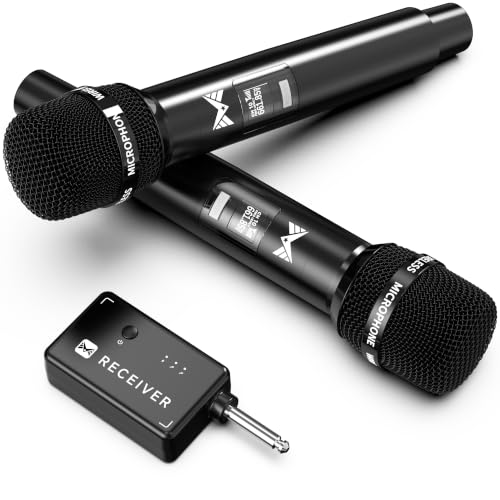
Wireless Microphone Review Summary
If you want a straightforward wireless mic for karaoke, speeches, or party hosting, this product makes sense because it prioritizes convenience over complexity.
The listing points to low-latency transmission, a metal microphone head, and broad compatibility with karaoke machines, powered speakers, and amplifiers through a 6.35 mm receiver path, which should appeal to buyers who want a fast setup instead of a feature-heavy audio rig.
The best fit is a casual to mid-level user who needs a wireless microphone that is easy to deploy, carries far enough for room or outdoor use, and is built for long sessions.
It is less compelling if you need studio-grade control, XLR workflow, or AUX-only compatibility, because the product explicitly warns against AUX jack use.
Review Scorecard
| Category | Score | Rationale |
|---|---|---|
| Setup simplicity | 9/10 | Plug-and-play positioning and a direct receiver connection reduce friction. |
| Wireless stability | 8/10 | One-to-one chip connection is aimed at stable, low-latency transmission. |
| Battery endurance | 9/10 | The stated 40-hour battery life is a strong fit for long events. |
| Range and mobility | 8/10 | The claimed 200-foot range supports room-sized and outdoor use. |
| Sound handling | 7/10 | DSP, high-fidelity sound, and anti-howling are useful, but still listing claims. |
| Build and durability | 7/10 | Metal microphone head suggests a more durable, polished design. |
| Buyer flexibility | 6/10 | Good for karaoke and speaking, but the jack compatibility warning limits some setups. |
Key Features and Specifications of Wireless Microphone
The core appeal here is practical rather than technical.
The microphone uses a metal head, the listing emphasizes DSP-based noise suppression, and the wireless link is described as a one-to-one chip connection intended to reduce latency and improve stability.
The receiver works with 6.35 mm microphone-jack input and includes a 3.5 mm adapter path for microphone jacks, not AUX.
That distinction matters a lot: the product is not trying to be universal, and buyers should match their speaker or amplifier input before ordering.
Other listed specs are easy to understand and easy to evaluate:
- 200-foot connection range
- Up to 40 hours of battery life
- 1200 mAh built-in battery
- Plug-and-play operation
- Intended for singing, speech, karaoke, live performance, and party use
- Anti-howling support
That combination makes the product most attractive for people who want a self-contained wireless microphone for everyday events rather than a modular pro-audio system.
Pros and Cons of Wireless Microphone
Pros
- Easy plug-and-play setup
- Long stated battery life for extended use
- Strong claimed range for home, party, or outdoor use
- Low-latency one-to-one connection approach
- Metal microphone head should feel more robust than basic plastic designs
- Anti-howling and DSP claims align well with karaoke and speech use
Cons
- Not compatible with AUX jack input
- More focused on convenience than deep audio control
- Listing claims are broad and not backed by measured lab data
- Best suited to microphone-jack workflows, so some consumer speakers may need checking first
Who Should Buy Wireless Microphone?
Buy this if you want a wireless microphone for karaoke nights, family gatherings, school-style presentations, community speaking, or casual live performance.
The combination of simple setup, long battery life, and a stated 200-foot range is well matched to people who value portability and speed over professional audio routing.
It is also a reasonable choice for users who want a microphone that can move between indoor and outdoor settings without fuss.
The receiver format and plug-and-play design suggest a product built for fast deployment, not a learning curve.
Skip it if you need AUX-only compatibility, studio recording features, or a more advanced system with pro mixer integration. The listing language points to a practical handheld mic, not a full wireless audio platform.
Sound and Setup Practicality of Wireless Microphone
Plug-and-Play Workflow
The main advantage is how little setup it appears to require.
For buyers who hate pairing menus, app dependence, or complex receiver tuning, that is a real selling point.
The product is clearly aiming at quick success out of the box.
Range and Event Use
The stated 200-foot range is useful for party hosts, presenters, and people moving around a room or stage.
That is especially relevant for karaoke and speech situations where physical freedom matters more than pristine studio isolation.
Battery Life and Session Length
A 40-hour battery claim changes the buying conversation because it reduces the anxiety of mid-event charging.
If that figure holds in normal use, it is a major strength for anyone hosting longer gatherings or using the mic across repeated sessions.
Compatibility Limits
The product’s compatibility warning is one of its most important buying signals.
If your speaker only offers AUX input, this is probably the wrong purchase.
If you do have a microphone jack or powered speaker setup, the fit is much better.
Alternatives to Wireless Microphone
If you want a similar wireless karaoke-style setup, look at Bietrun wireless microphone, which is often positioned for simple handheld use and home events.
For buyers who want a more established audio brand, Shure wireless microphone is the safer search path when durability and brand confidence matter more than low-friction value.
If your use case leans toward stage speaking or church-style presentation, FIFINE wireless microphone is worth comparing because it often targets practical, budget-friendly wireless setups.
For a more performance-oriented karaoke option, TONOR wireless microphone is another plausible Amazon alternative with a similar consumer-friendly pitch.
Is Wireless Microphone Worth It?
Yes, if your priority is simple wireless use for karaoke, speech, or party hosting and your speaker setup accepts the right microphone input. The mix of plug-and-play operation, long battery life, and stated low-latency transmission gives it a clear practical appeal.
It is not the right choice for buyers who need AUX compatibility or professional audio flexibility.
For the right setup, though, it looks like a sensible, convenience-first purchase rather than an overcomplicated one.