Stage snakes with multichannel XLR connections keep microphones and other balanced audio lines organized between the stage and mixer. The right model can reduce cable clutter, speed setup, and make a live rig easier to troubleshoot.
This roundup compares 10 options across compact 8- and 12-channel designs, versatile 16-channel snakes, and higher-capacity 24- and 32-channel models. Use the buying guide below to match channel capacity, cable length, connector layout, and construction to your venue or production.
Best 10 Stage Snakes with Multi Channel Picks for 2026
Best Overall Splitter
Seismic Audio 16-Channel Low-Profile Snake

- 16 channels with 12 sends and 4 returns
- Low-profile stage box with circuit-board connections
- 50-foot cable with labeled, color-coded ends
Best For: Professional live sound routing with flexible send-and-return connections
Best Straightforward 16-Channel Option
Harmony Audio HA-SB1650 16-Channel Snake

- 16 channels with 12 sends and 4 returns
- 50-foot XLR cable for stage connections
- Braided nylon exterior for regular handling
Best For: Live sound and studio setups needing a conventional 16-channel snake
Best Compact Setup
PRORECK 8-Channel Low-Profile Snake

- 8 sends and 4 returns over 50 feet
- Low-profile box with numbered connectors
- Circuit-board design supports noise reduction
Best For: Smaller live, recording, stage, and studio setups
Best Long-Run Capacity
Harmony Audio 24-Channel 100-Foot Snake

- 24 channels with 20 sends and 4 returns
- 100-foot cable for extended stage runs
- Braided nylon exterior and broad equipment compatibility
Best For: Large productions needing high channel capacity and long reach
Compact 8-Channel Pick

- Eight numbered XLR channels
- 25-foot cable with compact box
- Circuit board helps reduce external noise
Best For: Smaller live, recording, and studio setups
Long-Run 16-Channel Pick

- Sixteen XLR channels
- 100-foot stage-to-mixer reach
- Built for venues and studio applications
Best For: Large stages and long professional audio runs
Expanded Send/Return Pick
Speakers 16x4 100-Foot XLR Snake

- Sixteen sends plus four returns
- 100-foot low-profile configuration
- Marked connectors and circuit-board design
Best For: Complex live and studio routing setups
Long-Run 32-Channel Workhorse
Harmony Audio 150-Foot 32-Channel Snake
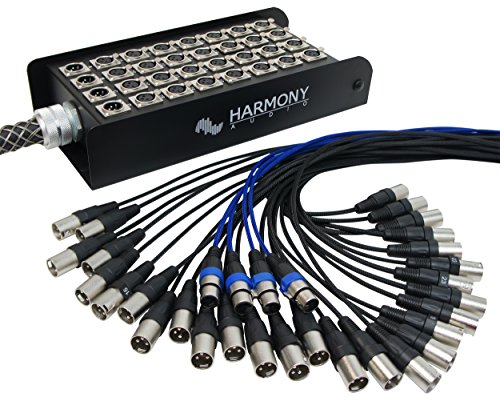
- 28 sends and 4 returns
- 150-foot XLR run
- Labeled, shielded connections
Best For: Large stages and long cable runs
Compact Circuit-Board Routing
Speakers 12-Channel Low-Profile Snake

- 12 sends and 4 returns
- Low-profile 50-foot stage box
- Clearly marked connections
Best For: Compact live, recording, and studio rigs
Mid-Length High-Capacity Run
Harmony Audio 100-Foot 32-Channel Snake
- 28 sends and 4 returns
- 100-foot XLR cable
- Shielded and clearly labeled
Best For: Medium-to-large live and studio setups
Best Overall Splitter – Seismic Audio 16-Channel Low-Profile Snake
For stage snakes with multi channel routing, this 50-foot Seismic Audio model combines 16 channels, a low-profile stage box, and circuit-board connections. Its 12 sends and 4 returns are suited to professional audio setups where clear labeling and a compact footprint help speed up connections.
Best For: Live sound and professional audio systems needing a durable 16-channel send-and-return snake.
Pros:
- 16 channels with 12 sends and 4 returns for flexible routing.
- Low-profile stage box helps reduce footprint.
- Individually shielded conductors and circuit-board technology support noise rejection and solid connections.
- Numerically labeled, color-coded connections simplify setup and teardown.
Cons:
- At 11.5 pounds, it is not the lightest option.
- The 50-foot length may be more cable than needed for compact setups.
This is a practical all-around choice when you want broad channel capacity, clear identification, and a road-ready design without adding converters or couplers.
Best Straightforward 16-Channel Option – Harmony Audio HA-SB1650 16-Channel Snake
This Harmony Audio snake is a straightforward choice for stage snakes with multi channel routing, providing 16 XLR channels over 50 feet. Its 12-send, 4-return layout fits live sound and studio applications, while the braided nylon outer material is designed for regular handling.
Best For: Live sound and studio users who need a conventional 16-channel XLR stage box.
Pros:
- Provides 12 sends and 4 returns across 16 channels.
- 50-foot length supports stage-to-console connections.
- Braided nylon outer material adds a durable exterior.
- Male-to-female XLR configuration works with standard XLR equipment.
Cons:
- At 19.6 pounds, it is relatively heavy.
- The supplied notes do not identify low-profile construction or circuit-board technology.
Choose this model when you prefer a traditional, clearly specified XLR snake and need balanced send-and-return capacity for live or studio work.
Best Compact Setup – PRORECK 8-Channel Low-Profile Snake
For smaller systems using stage snakes with multi channel routing, the PRORECK 8-channel model keeps the layout manageable with an 8-send, 4-return configuration and a 50-foot cable. Its low-profile box, numbered connections, and circuit-board design are useful for live, recording, stage, and studio applications.
Best For: Smaller stage or studio systems that need clearly marked XLR routing in a compact design.
Pros:
- 8 send channels and 4 return channels cover common smaller setups.
- Low-profile design helps reduce the stage footprint.
- Numbered box and fantail connectors make connections easier to identify.
- Circuit-board connections are intended to reduce external noise and support clearer sound.
Cons:
- Fewer send channels than the 16- and 24-channel alternatives.
- The supplied details specify indoor usage.
- Only a 50-foot length is listed.
This is a sensible pick when channel requirements are moderate and easy identification, portability, and a compact stage box matter more than maximum capacity.
Best Long-Run Capacity – Harmony Audio 24-Channel 100-Foot Snake
When a larger production needs stage snakes with multi channel routing, this Harmony Audio HA-SB24100 provides 24 channels across a 100-foot run. With 20 sends and 4 returns, it is designed for audio transmission between microphones, mixers, interfaces, and other professional audio equipment.
Best For: Large stages and installations requiring extended reach and high send-channel capacity.
Pros:
- 24-channel layout includes 20 sends and 4 returns.
- 100-foot length supports long stage-to-console runs.
- Compatible with audio interfaces, mixers, microphones, and professional audio equipment.
- Braided nylon outer material provides a durable cable exterior.
Cons:
- At 45.3 pounds, it is substantially heavier than shorter snakes.
- The 100-foot length can be excessive for small venues or short runs.
- Its larger capacity may be unnecessary for basic setups.
This model makes the most sense for complex productions where extra send channels and long reach justify the added size and weight.
Compact 8-Channel Pick – PRORECK 25-Foot XLR Snake
For smaller setups, this 25-foot PRORECK model is a practical choice among stage snakes with multi channel routing. It provides eight numbered XLR channels, a low-profile send box, and a circuit board designed to support solid connections with reduced external noise.
Best For: Live performances, recording sessions, stage setups, and studio applications where an 8-channel, 25-foot snake is sufficient.
Pros:
- Eight XLR channels with numbered connectors for easier setup.
- Includes four female XLR connectors on the box and eight male fantail connectors.
- Rugged cord material and circuit-board construction support regular use.
- Can connect directly to analogue or digital consoles without converters.
Cons:
- The 25-foot length may not suit larger stages or long console runs.
- Provides fewer channels than the 16-channel alternatives in this roundup.
The PRORECK is best when portability and a manageable cable run matter more than maximum channel capacity. Its clear numbering and compact 8-channel layout make it straightforward for smaller stage or studio systems.
Long-Run 16-Channel Pick – GEARit 100-Foot XLR Snake
When a console must sit far from the stage, the GEARit 100-foot model offers the reach expected from stage snakes with multi channel signal routing. Its 16-channel XLR design is suited to carrying multiple signals between a mixer, processing equipment, speakers, and monitors.
Best For: Larger venues, recording studios, and professional audio applications requiring a 100-foot, 16-channel XLR connection.
Pros:
- Sixteen channels provide substantial signal capacity for stage systems.
- 100-foot length supports long runs between stage and mixer.
- Designed for recording studios, venues, live performances, and sound engineering.
- XLR male-to-female connectivity works with compatible professional audio equipment.
Cons:
- At 26.1 pounds, it is less convenient to transport than shorter snakes.
- The long cable may be excessive for compact stages or nearby equipment.
The GEARit stands out for reach and channel count rather than compactness. Choose it when a 16-channel connection and 100-foot run are central to the installation, and plan for its heavier handling requirements.
Expanded Send/Return Pick – Speakers 16×4 100-Foot XLR Snake
This Speakers model is designed for complex routing needs, combining 16 sends and four returns in a 100-foot XLR snake. For buyers comparing stage snakes with multi channel configurations, its low-profile box, clearly marked connections, and direct console compatibility offer a practical stage-to-console setup.
Best For: Live, recording, stage, and studio systems that need 16 send channels plus four return channels over a 100-foot run.
Pros:
- Combines 16 sends and four returns for expanded signal routing.
- 100-foot length accommodates substantial stage layouts.
- Low-profile stage box helps reduce footprint.
- Numbered connections and circuit-board construction support identification and reliable connections.
Cons:
- The 7.6-pound cable is less compact than a short 8-channel option.
- Its 16×4 configuration may provide more routing than a basic setup needs.
- A 100-foot cable can be harder to manage in small rooms.
The main advantage here is flexibility: four returns are available alongside the 16 sends, making this a stronger fit for more involved stage systems. Its low-profile box and marked ends help keep a large connection layout manageable.
Long-Run 32-Channel Workhorse – Harmony Audio 150-Foot 32-Channel Snake
For larger venues and fixed stage layouts, this Harmony Audio model is a substantial choice among stage snakes with multi channel routing. It provides 28 sends and 4 returns across a 150-foot XLR run, with labeled inputs and returns to simplify setup.
Best For: Large live-sound stages, longer cable runs, and studio applications that need 32 channels.
Pros:
- 32-channel design with 28 sends and 4 returns
- 150-foot length supports distant stage boxes
- 3-pin, male-to-female XLR connections with 100% shielded cable
- Numerical input labels and A–D return labels aid identification
Cons:
- At 80 pounds, it is a heavy option to transport
- The 150-foot length may be excessive for smaller setups
This is the strongest fit when reach and channel capacity matter more than portability. Its labeled, shielded XLR construction is practical for demanding live-sound or studio routing.
Compact Circuit-Board Routing – Speakers 12-Channel Low-Profile Snake
This Speakers snake is a practical option for buyers seeking stage snakes with multi channel routing in a smaller footprint. Its low-profile box provides 12 sends and 4 returns over 50 feet, while clearly marked connections help identify channels during live, recording, stage, or studio work.
Best For: Compact live-sound rigs, recording setups, and stages needing 12 sends with 4 returns.
Pros:
- Low-profile stage box reduces footprint
- Offers 12 channels and 4 returns over a 50-foot cable
- Circuit-board design is intended to support solid, noise-resistant connections
- Clearly marked cable ends and box connections simplify setup
Cons:
- 50-foot length is shorter than the larger Harmony Audio options
- Its 12-send capacity may not suit high-channel-count productions
Choose this model when space and straightforward channel identification are priorities. It connects directly to analog or digital consoles without converters, according to the supplied product information.
Mid-Length High-Capacity Run – Harmony Audio 100-Foot 32-Channel Snake
For systems that need substantial channel capacity without the full reach of a 150-foot cable, this Harmony Audio model is a balanced pick among stage snakes with multi channel connectivity. It carries 28 sends and 4 returns over 100 feet and uses labeled, shielded XLR cabling for organized routing.
Best For: Professional live sound, studio recording, and stage setups requiring 32 channels across a 100-foot run.
Pros:
- 32-channel configuration with 28 sends and 4 returns
- 100-foot length suits many medium-to-large stage layouts
- 3-pin male-to-female XLR connectors and 100% shielded cable
- Numerical inputs and A–D return labels make channels easier to trace
Cons:
- At 56.5 pounds, it remains relatively heavy for transport
- May provide more channels and cable length than smaller productions need
This model offers a useful middle ground between compact snakes and extra-long runs. It is well suited to buyers who want the same 32-channel layout in a more manageable 100-foot format.
How We Picked These Stage Snakes with Multi Channel
We selected models that cover the most common live-sound requirements, from compact setups and rehearsal spaces to larger stage boxes with extensive send and return capacity. The lineup includes 8-, 12-, 16-, 24-, and 32-channel configurations, plus cable lengths from 25 to 150 feet.
Our comparison emphasizes practical specifications: total channel count, send-to-return allocation, overall reach, connector accessibility, and whether the snake is better suited to portable use, fixed installations, recording, or full-band stage work. Because product construction can vary by batch and seller, verify connector type, pin configuration, and included hardware before ordering.
Quick Comparison
| Setup type | Recommended capacity | Typical cable length | Best fit |
|---|---|---|---|
| Small rehearsal or compact stage | 8–12 channels | 25–50 feet | Small bands, classrooms, and compact recording spaces |
| Typical live-band rig | 16 channels | 50–100 feet | Vocals, instruments, monitors, and general PA use |
| Larger stage or production setup | 24–32 channels | 100–150 feet | Festivals, venues, theaters, and expanded input counts |
Key Buying Factors for Stage Snakes with Multi Channel
Channel Count and Send/return Layout
Choose based on the number of separate balanced lines you need—not just the number of microphones in today’s setup. Leave spare channels for guest inputs, playback, wireless systems, monitor feeds, or future expansion. A snake with dedicated returns can send signals back to powered speakers, monitors, or amplifiers without running separate cables.
Length and Routing
Measure the actual path from the stage box to the mixer, including turns, risers, and overhead routing. A 50-foot cable may suit a small room, while 100- or 150-foot models provide useful reach for larger venues. Avoid excessive slack where possible, since long unused loops add weight and create trip hazards.
Connector Arrangement and Footprint
Low-profile boxes are useful when floor space is limited or the stage box must sit near a wall, rack, or drum riser. Check whether the connectors face upward, forward, or sideways and confirm that the layout works with your microphone and patch cables. Clearly labeled channels can also save time during setup and troubleshooting.
Construction and Handling
Look for a cable jacket and strain relief appropriate to repeated transport. Store the snake in loose, consistent coils rather than tight bends, and protect the stage box from impact and moisture. For permanent installations, prioritize the required reach and connector compatibility over portability.
Who Should Buy Which Stage Snakes with Multi Channel?
Choose an 8- or 12-channel snake for a compact acoustic act, rehearsal room, small recording setup, or simple presentation system. A 16-channel model is the most flexible middle ground for many bands and small venues. Move to 24 or 32 channels when you need extensive drum miking, multiple monitor feeds, spare inputs, or a long stage-to-mixer run.
For short distances, the 25-foot option minimizes excess cable. For typical venues, 50 feet offers a practical balance. Select 100- or 150-foot versions when the console is positioned at the back of a room or in a separate control area. Before purchase, confirm the exact send/return count and connector configuration so the snake matches your mixer, stage box, and patching workflow.