A studio door can undermine an otherwise careful acoustic setup when its perimeter has visible gaps or a loose threshold. The right thick door seal helps close those leaks while also limiting drafts, dust, and light.
This roundup compares 10 options across adhesive foam, rubber, silicone, kerf-fit, and complete door-seal designs. Pay close attention to gap size, installation method, durability, and whether the door sweep is included.
Best 10 Thick Studio Door Seals Picks for 2026
Large-Gap Pick

- Seals 5/16- to 15/32-inch gaps
- Self-adhesive, tool-free installation
- Multi-hole design helps reduce sound
Best For: Large-gap door frames needing an adhesive seal
Studio Kit Pick
Soundproofing Acoustic Door Seal Kit

- Includes seals and a door sweep
- Designed for sound gaps around doors
- Treats up to four standard doors
Best For: Multi-door studio or apartment sound-control projects
No-Adhesive Pick

- Push-in installation needs no adhesive
- Fits 0.35- to 0.59-inch slots
- Helps block light, drafts, and noise
Best For: Compatible grooved door frames
Maximum Coverage Pick

- Covers gaps from 3/10 to 7/8 inch
- 40-foot roll for larger projects
- Includes four cushioning gaskets
Best For: Large-gap doors with compatible 1/8-inch grooves
Clear T-Seal Grip

- Two adhesive faces help secure the T-shaped seal.
- Clear silicone offers a discreet appearance.
- 20-foot strip helps cover multiple door areas.
Best For: Doors needing a clear, flexible seal with a secure hold
Wide Gap Barrier

- Wide profile covers gaps up to 1.2 inches.
- Two rolls provide 33 feet of total material.
- Useful for doors, windows, and shower glass.
Best For: Wide interior door gaps and multipurpose household sealing
Best Flexible Foam Coverage

- Long 33-foot roll for multiple projects
- Soft, larger foam fills wider gaps
- Mesh-reinforced adhesive backing
Best For: DIY sealing, cushioning, and insulation across doors, windows, and household surfaces
Best for Large Door Gaps
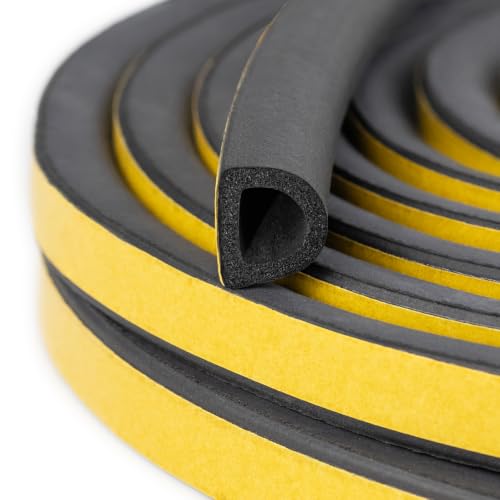
- Fits specified 5/16–15/32-inch gaps
- Flexible hollow EPDM profile
- Helps reduce drafts, dust, and light leaks
Best For: Large-gap entry, exterior, and RV doors
Best for Smaller Gaps

- Fits recommended 1/8–1/4-inch gaps
- Flexible silicone handles temperature changes
- Adhesive promoter included for smooth surfaces
Best For: Small door and window gaps in rooms, offices, cabinets, and frames
Large-Gap Pick – VITAM AMO EPDM Door Seal
For thick studio door seals that need to handle a substantial gap, this 18-foot EPDM strip covers openings from 5/16 to 15/32 inch. Its self-adhesive backing and flexible, multi-hole design make it a practical option for reducing drafts, light, and some sound around doors or windows.
Best For: Large-gap door frames where easy, adhesive installation and added sound reduction are priorities.
Pros:
- Seals gaps from 5/16 to 15/32 inch.
- EPDM rubber is designed for flexibility, durability, and low-temperature use.
- Self-adhesive installation requires no tools or special experience.
- Multi-hole construction helps reduce sound propagation and closing pressure.
Cons:
- The adhesive-backed design may be less suitable if you want a removable seal.
- The 18-foot roll may require purchasing additional rolls for larger installations.
This is a strong all-around choice when a thick studio door seal must fill a wide gap while also helping control air, light, and noise. Measure the frame carefully before installation.
Studio Kit Pick – Soundproofing Acoustic Door Seal Kit
Audimute Soundproofing Acoustic Door Seal Kit - Door Sweep and Seal - (Large Size)
Check Price On AmazonThis acoustic kit is a convenient approach to thick studio door seals because it combines perimeter seals with a door sweep. The included materials are designed to address gaps around the door and can treat up to four standard-size doors.
Best For: Apartments, studios, and multi-door projects that need both frame sealing and a bottom sweep.
Pros:
- Includes two 50-foot door seals and one 25-foot door sweep.
- Designed to help block sound traveling through gaps around doors.
- Can treat up to four standard-size doors.
- Easy to install according to the supplied product information.
Cons:
- The supplied notes do not specify the exact gap range it fits.
- It is a larger kit than needed for a single small door.
Choose this kit when sound control is the main goal and you want coverage for both the door perimeter and bottom edge. Its multi-door quantity can be especially useful for a studio or apartment project.
No-Adhesive Pick – Ravinte Q-Shaped Kerf Seal
For thick studio door seals without adhesive, the Ravinte Q-shaped strip installs by pushing it into an existing door-frame groove. Its high-density foam core is intended to block light, drafts, dust, water, and some noise while fitting slots from 0.35 to 0.59 inch.
Best For: Doors with compatible kerf slots where a clean, removable-style push-in installation is preferred.
Pros:
- Fits slots from 0.35 to 0.59 inch.
- No adhesive is required, so it will not leave adhesive marks.
- High-density foam core helps block light and reduce noise.
- 26-foot length provides coverage for many door installations.
Cons:
- Requires a compatible groove or recess in the door frame.
- You must measure the slot before ordering to confirm fit.
This is a practical choice for a kerf-style frame, especially when you want to avoid sticky installation. Confirm the groove dimensions first, since it is not intended for a plain, ungrooved frame.
Maximum Coverage Pick – 40FT Large-Gap Kerf Seal
This 40-foot kerf seal is suited to thick studio door seals where the frame has a groove and the gap is unusually large. Its upgraded V-shaped profile is rated for gaps from 3/10 to 7/8 inch, while the layered construction targets wind, dust, water, light, and noise reduction.
Best For: Large-gap doors with 1/8-inch grooves and projects that need substantial roll length.
Pros:
- Seals a broad 3/10- to 7/8-inch gap range.
- 40-foot length suits doors of various sizes and multi-door work.
- PE grid surface and high-density PU foam core provide flexible sealing construction.
- Includes four foam gaskets for cushioning or difficult closing situations.
Cons:
- Requires a door-frame groove for installation.
- The supplied instructions specify a 1/8-inch groove and 5/32-inch ridge, so compatibility must be checked carefully.
- The included gaskets may be unnecessary for a straightforward installation.
Among these thick studio door seals, this option offers the widest stated gap coverage and the longest roll. It is best for larger or multiple doors, provided the frame groove matches the required dimensions.
Clear T-Seal Grip – Flexible Silicone Door Seal
For thick studio door seals that need a low-visibility finish, this clear T-shaped silicone strip uses two adhesive faces to help stay securely attached along the door edge and front. Its flexible design helps close gaps, reduce drafts, and soften outside noise.
Best For: Exterior, front, back, or garage entry doors where a clear, flexible seal and secure two-sided adhesion are useful.
Pros:
- T-shaped profile provides two adhesive attachment surfaces.
- Clear silicone blends with various door colors.
- 20-foot roll can be cut to the required length.
- Helps reduce drafts, indoor air loss, dust, and outside noise.
Cons:
- At 1.37 inches wide, it may not suit every door gap or mounting surface.
- Adhesive preparation is important, especially in cold weather.
This is a practical choice when appearance matters alongside gap coverage. Measure the door and mounting area first, then clean, cut, and firmly press the strip into place.
Heavy-Duty Gap Coverage – 50-Foot D-Shape Rubber Seal
For thick studio door seals across several openings, this 50-foot D-shaped rubber strip offers generous coverage and a 0.23-inch profile for gaps from about 2.5 to 5.5 mm. The self-adhesive backing is designed for straightforward installation after the surface is cleaned.
Best For: Large projects involving door frames, windows, furniture, cabinets, or other applications matching the specified gap range.
Pros:
- 50-foot roll provides substantial material for multiple installations.
- Flexible rubber is designed to resist freezing and cracking in extreme temperatures.
- Self-adhesive backing installs by peeling and pressing.
- Tailor scissors are included for cutting to size.
Cons:
- Its 0.35-inch width and 0.23-inch thickness may be too small or large for some gaps.
- The product is intended for gaps of approximately 2.5 to 5.5 mm, so measurement is essential.
This option stands out for quantity and versatility rather than a wide profile. Allow the installed strip to set for 24 hours, and confirm the gap dimensions before ordering.
Wide Gap Barrier – 1.8-Inch Flexible Door Seal
For thick studio door seals covering wider openings, this 1.8-inch TPE strip is designed for gaps up to 1.2 inches and comes as two rolls totaling 33 feet. Its flexible construction can help block drafts, dust, smoke, insects, and light gaps around doors and windows.
Best For: Interior doors, sliding or wardrobe doors, windows, and shower glass door bottoms where broad gap coverage is needed.
Pros:
- Wide 1.8-inch profile accommodates gaps up to 1.2 inches.
- Two rolls provide a total listed length of 33 feet.
- Flexible TPE conforms to uneven gaps and door frames.
- Can also help reduce water splashes on shower glass door bottoms.
Cons:
- Its wide profile may be visually prominent on some doors.
- Clear adhesive backing requires thorough cleaning and firm installation.
- It is not intended for every gap size; measure before purchase.
This seal is a strong fit when gap width is the main concern and one strip may serve several household applications. For better adhesion, clean the surface and warm the backing briefly before pressing it down.
Best Flexible Foam Coverage – 33FT EVA Foam Door Seal
If you need thick studio door seals for uneven or oversized gaps, this 33-foot EVA foam strip offers flexible, cut-to-fit coverage. Its soft foam construction can help with drafts, light, sound, and everyday impact protection around doors and windows.
Best For: DIY projects requiring a long, flexible seal for doors, windows, vents, garages, or other household surfaces.
Pros:
- 33 feet of cut-to-fit EVA foam provides generous coverage.
- Upgraded mesh-reinforced adhesive is designed for a secure, low-residue bond.
- Soft, larger-profile foam can fill wider gaps than common foam strips.
- Useful for sealing, cushioning, insulation, sound reduction, and light blocking.
Cons:
- Foam may be less suited to high-wear locations than rubber or silicone.
- The notes do not specify a recommended gap range.
This is the most versatile option of the three for broad, irregular sealing jobs. Measure the gap first, clean and dry the surface, then cut and press the strip firmly into place.
Best for Large Door Gaps – 20FT EPDM D-Shaped Seal
For thick studio door seals around a notably uneven opening, this hollow D-shaped EPDM strip is designed for gaps from 5/16 to 15/32 inch. The compressible profile helps accommodate repeated door movement while reducing drafts, dust, light leaks, and some outside noise.
Best For: Entry doors, RV doors, exterior doors, and window frames with measured large gaps in the specified range.
Pros:
- Designed for larger 5/16–15/32-inch gaps.
- Flexible EPDM rubber remains usable in hot and cold weather.
- Hollow D shape compresses and rebounds during repeated opening and closing.
- Mesh-reinforced self-adhesive backing supports straightforward installation.
Cons:
- At 20 feet, it provides less material than the 33-foot foam roll.
- Requires accurate gap measurement before installation.
- Adhesive needs a clean, dry surface and up to 24 hours to bond.
This is the more targeted choice when your door has a large, clearly measurable gap. Test the closed-gap fit before removing the backing, and warm the adhesive in cold conditions.
Best for Smaller Gaps – 20FT Silicone D-Shaped Seal
When thick studio door seals need to handle smaller, consistent gaps, this 20-foot silicone D-shaped strip is sized for approximately 1/8- to 1/4-inch openings. Its flexible profile compresses around door and window frames to help limit drafts, dust, moisture, light, and everyday noise.
Best For: Bedrooms, offices, living rooms, cabinets, and other frames with small gaps that fall within the recommended range.
Pros:
- Silicone construction stays flexible through changing temperatures.
- Recommended for 1/8- to 1/4-inch gaps.
- 20-foot roll can be cut to fit different projects.
- Included adhesive promoter can strengthen bonding on smooth surfaces.
Cons:
- Not intended for the larger gaps covered by the EPDM D-shaped seal.
- Provides less total coverage than the 33-foot EVA option.
- Requires careful surface preparation for long-term adhesion.
This option makes sense for smaller door or window gaps where a soft silicone seal is preferable. Confirm the gap size, clean and dry the frame, and use the adhesive promoter when appropriate.
How We Picked These Thick Studio Door Seals
We focused on products suited to doors with moderate to large perimeter gaps, prioritizing useful width and thickness, practical installation, and materials that can tolerate regular opening and closing. The selection includes self-adhesive strips for quick upgrades, kerf seals for compatible door frames, and kits that address both the sides and bottom of a door.
Because weatherstripping is not the same as professional acoustic isolation, we treated sound reduction as a benefit of better gap coverage rather than a guaranteed performance rating. A seal works best when it compresses evenly without preventing the door from latching.
Quick Comparison
| Seal style | Best suited to | Main advantage | Watch out for |
|---|---|---|---|
| Adhesive foam | Fast, budget installations | Simple to cut and apply | May compress or wear sooner |
| D-shaped rubber or silicone | Large, consistent gaps | Durable compression seal | Needs a clean, flat mounting surface |
| Q-shaped or T-shaped strip | Specific door-frame profiles | Neater, more secure fit | Profile and channel dimensions must match |
| Kerf weatherstripping | Frames with a retention slot | Clean installation without adhesive | Not compatible with every frame |
| Door-seal kit | Perimeter and threshold leaks | Addresses more than one leak path | Check included lengths and hardware |
Key Buying Factors for Thick Studio Door Seals
Measure the Gap First
Measure the largest gap between the closed door and frame, ideally at the top and both sides. Choose a seal that can fill that space while compressing slightly. An oversized strip can make the door difficult to close; an undersized one will leave an air path.
Match the Installation Type
Self-adhesive backing is convenient, but it requires a clean, dry, smooth surface. Kerf products need a compatible slot in the frame, while T-shaped designs may require a particular channel or mounting profile. Confirm the product dimensions before ordering.
Consider the Material
Foam is easy to install and often inexpensive, making it useful for temporary or low-wear applications. Rubber and silicone generally provide better resilience for frequently used studio doors. Clear silicone can be less noticeable, while black rubber may better hide dirt and wear.
Do Not Overlook the Threshold
Perimeter seals cannot close the gap beneath a door. If sound, light, or drafts still pass underneath, choose a door sweep or a kit that includes one. Make sure the sweep clears flooring and does not drag excessively.
Who Should Buy Which Thick Studio Door Seals?
Choose adhesive foam when you need a quick, inexpensive improvement or are testing the correct thickness. Pick a D-shaped rubber or silicone strip for a frequently used door with a broad, predictable gap. Kerf weatherstripping is the better choice when your frame already has the required retention channel and you want a cleaner long-term installation.
A Q-shaped or T-shaped profile makes sense when replacing an existing insert with matching dimensions. For a studio with noticeable leakage at both the sides and bottom, a complete acoustic door-seal kit is the most practical starting point. Whichever style you choose, install it around a clean frame, test the latch, and trim only after confirming the door closes evenly.